


Introduction
What happens when one weak password, compromised device or unsecured connection gives an attacker a way into a business network? Network Security works behind the scenes to reduce these risks by protecting users, devices, applications, data and the connections between them.
From office networks and wireless devices to cloud applications and remote access, modern organisations depend on secure connectivity every day. Network Security combines technologies, policies and practices to prevent unauthorised access, detect suspicious activity, protect sensitive information and keep critical services available.
What is Network Security?
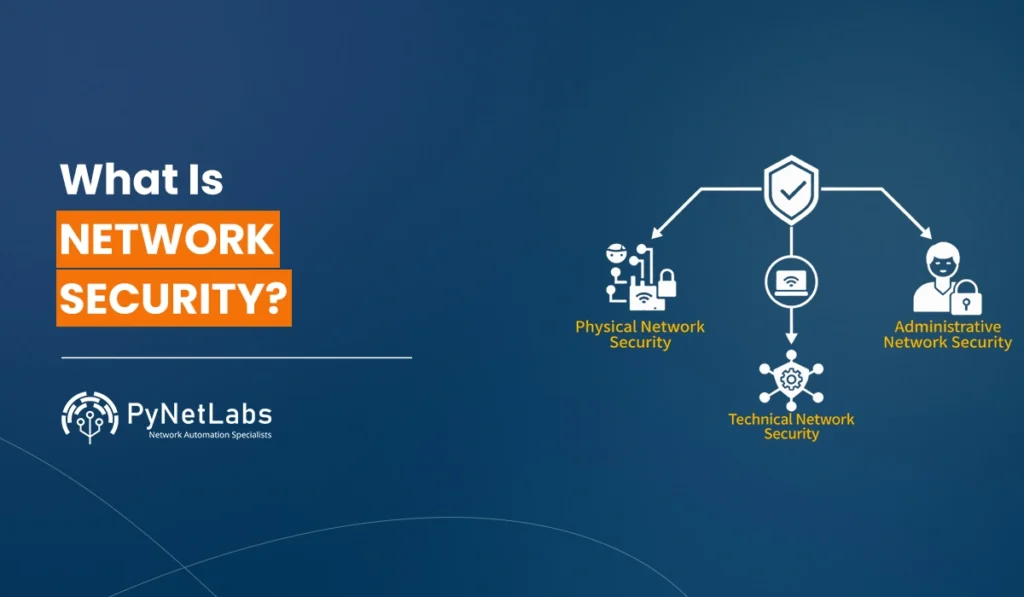
Network Security is the practice of protecting computer networks, connected devices, applications and the data moving between them from unauthorised access, misuse, attacks and disruption. It combines security technologies, policies and processes to control network access and protects communication.
The goal of Network Security is not simply to stop attackers from entering a network. It also aims to protect the confidentiality, integrity and availability of information and services. These three principles are commonly known as the CIA triad and form an important foundation of information and Network Security.

Why Network Security Matters?
Most businesses cannot work for long without their network. Orders, invoices, customer support, internal messages, and daily reports all depend on connected systems. An attack can interrupt these services within minutes. It may also expose private records, damage files, or leave employees unable to use important applications. The cost is not limited to repairing computers.
A business may lose sales, miss deadlines, face legal problems, and spend months rebuilding customer trust. Smaller companies are not ignored by attackers. Many attacks use automated tools that search the internet for weak passwords, outdated software, and poorly protected connections. Network Security reduces this risk. It gives the business a better chance of preventing an incident and responding quickly when something goes wrong.
How Network Security Works?
Network Security uses multiple layers of controls rather than relying on a single security product. Each layer performs a different function, such as controlling access, inspecting traffic, detecting threats or limiting the impact of a compromised device. A typical Network Security process can be understood through the following steps:
1. Identify Users and Devices
The first step is determining who or what is requesting access. This may involve employees, administrators, applications, mobile devices, servers or external services. Authentication and device checks help establish whether the user or device is legitimate.
2. Control Network Access
Once a user or device is identified, access policies determine what resources it can use. Firewalls, network access control, identity systems and role-based permissions can restrict access according to security requirements.
3. Inspect Network Traffic
Security controls inspect network traffic to identify connections that violate established policies or show signs of malicious activity. Firewalls and intrusion prevention systems are commonly used for traffic filtering and threat detection.
4. Monitor for Suspicious Activity
Network Security does not stop once access is granted. Security teams and monitoring tools continue looking for unusual login attempts, suspicious connections, malware activity, abnormal traffic and other indicators of compromise.
5. Detect and Respond to Threats
When suspicious activity is detected, security controls can block traffic, terminate sessions, isolate devices or generate alerts for investigation. Rapid response helps limit the potential impact of an incident.
6. Recover and Improve
After an incident, organisations need to restore affected systems, investigate the cause and improve their controls. Backups, incident response procedures and regular security reviews help strengthen the network over time.
Learn Fortinet FortiGate Firewall from fundamentals to advanced security with Fortinet FortiGate Firewall Course – Sign up today!
Network Security Diagram
A Network Security diagram is a simple map of the network. It shows connected systems, traffic paths, and the security controls placed between different areas. Most diagrams begin with the internet and outside users. Their traffic usually reaches a firewall or secure gateway before entering any business system. Public services, such as a company website, often sit in a separate area. Visitors can reach those services without gaining direct access to internal applications.
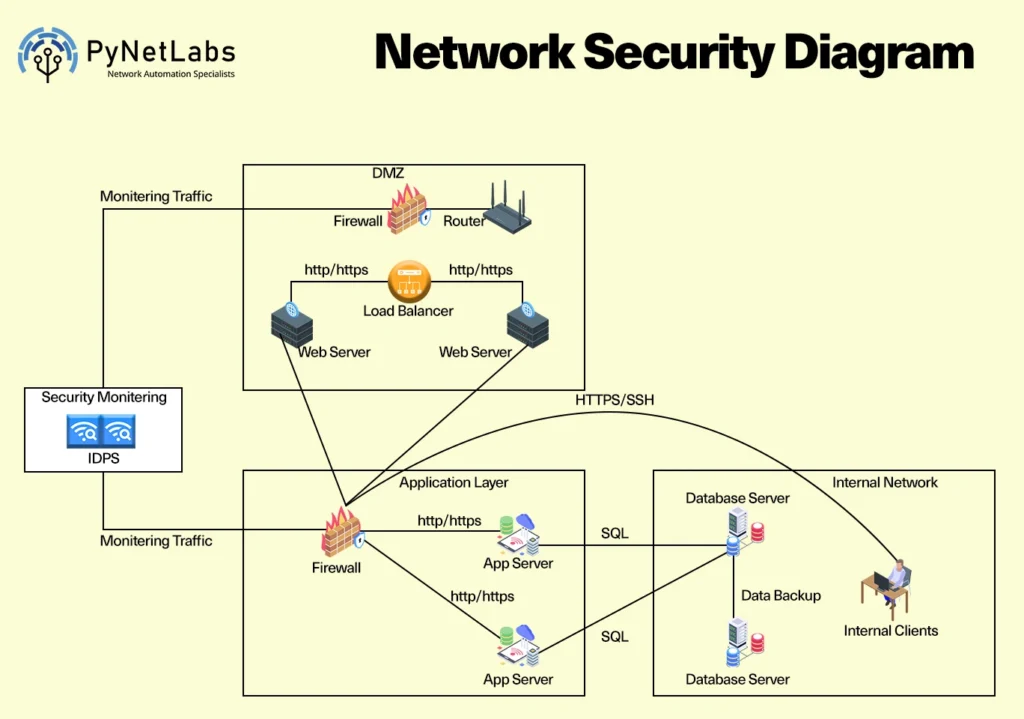
Employee devices and business software appear further inside the diagram. Sensitive databases sit behind additional controls because they hold more valuable information. Remote workers, wireless devices, cloud platforms, and suppliers may have their own connection paths. Each path should include suitable identity and security checks.
Network Security Architecture
Network Security architecture describes how all security controls fit together. It covers technology, access rules, data movement, monitoring, and the people responsible for managing them. Good architecture begins with knowing what the business actually uses. Teams need a reliable list of devices, applications, users, cloud services, and important data.
The next step is deciding which resources need stronger protection. Payroll records, customer details, payment systems, and administrator accounts normally require tighter access. Networks are then divided into smaller sections. This prevents an infected laptop from freely reaching databases, production systems, or other sensitive areas. The design should also include backups and recovery plans. Prevention is important, but every business needs a practical response when a control fails.
Network Security Types
There is no single technology that can protect every network from every threat. Organisations generally combine different Network Security controls according to their infrastructure, applications, users and risk profile. Here the following are the types of Network Security types:
Firewalls
A firewall monitors and filters network traffic according to predefined security rules. It can allow legitimate connections while blocking unauthorised or potentially harmful traffic. Firewalls may be deployed at network boundaries, between internal network segments and in cloud environments. Modern next-generation firewalls can provide additional capabilities such as application-aware filtering and intrusion prevention.
Access Control
Access control determines which users and devices can connect to a network and what resources they are allowed to access. It follows the principle of least privilege by limiting permissions to what is required. Authentication, authorisation, role-based access control and network access control can work together to prevent unauthorised access.
Malware Protection
Malware protection helps detect and block malicious software such as viruses, worms, trojans, spyware and ransomware. It may operate on endpoints while also integrating with Network Security and monitoring systems. Keeping software updated and combining malware protection with access controls and monitoring provides stronger protection than relying on a single security tool.
Intrusion Detection and Prevention
An Intrusion Detection System (IDS) monitors network activity and generates alerts when it identifies suspicious or potentially malicious behaviour. An Intrusion Prevention System (IPS) can take the additional step of blocking or stopping detected malicious traffic. IDS and IPS are commonly used as part of a broader layered security strategy.
Virtual Private Networks
A Virtual Private Network (VPN) creates an encrypted connection between a user or network and another trusted endpoint. VPNs can help protect data transmitted across untrusted networks such as public Wi-Fi. VPN technology is commonly used for secure remote access and site-to-site connectivity.
Email Security
Email security protects users from malicious messages, phishing links, dangerous attachments and sender impersonation. Secure email gateways and filtering systems can identify and block many suspicious messages before they reach users. However, technology alone cannot eliminate phishing risk. Employee awareness and clear reporting procedures remain important.
Web Security
Web security protects users from malicious websites, downloads and web-based threats. Secure web gateways and URL filtering can prevent users from accessing known harmful destinations. Web security can also help organisations enforce acceptable-use policies and monitor risky web activity.
Data Loss Prevention
Data Loss Prevention (DLP) helps organisations identify and control the movement of sensitive information. Policies can restrict how confidential data is copied, emailed, uploaded or transferred. DLP can help reduce both accidental data exposure and unauthorised data transfers.
Network Segmentation
Network segmentation divides the network into separate security zones. It can prevent users and devices from communicating with systems that they do not need to access. Segmentation is particularly useful for protecting sensitive servers, databases and critical infrastructure from threats originating elsewhere in the network.
Wireless Security
Wireless security protects Wi-Fi networks from unauthorised access and interception. Strong authentication, encryption, secure configurations and separate guest networks help reduce wireless security risks. Business and guest traffic should generally be separated so that visitors do not receive unnecessary access to internal resources.
Cloud Network Security
Cloud Network Security protects workloads, applications, data and connections within cloud environments. It can include identity controls, network segmentation, encryption, firewalls, monitoring and secure configuration. As organisations increasingly use hybrid and multi-cloud environments, security controls must protect both traditional networks and cloud-based resources.
Zero Trust Security
Zero Trust removes the assumption that users or devices should automatically be trusted because they are inside a network. Access decisions are based on factors such as identity, device posture, context and the resource being requested. Modern Zero Trust approaches continuously verify access and apply least-privilege principles, making them particularly relevant to cloud, remote-work and distributed environments.
Common Network Security Threats
Malware remains a common threat. It includes viruses, spyware, worms, and other programs created to steal information or damage connected systems.
Ransomware is particularly disruptive because it locks files or systems and demands payment. Even with payment, there is no promise that everything will return safely.
Phishing attacks take a different route. They use convincing messages to make people share passwords, open harmful attachments, or visit fake login pages.
Attackers also try stolen passwords or repeatedly guess common ones. Weak or reused credentials can give them access without breaking any technical control.
Other threats include traffic floods, hidden interception, insider misuse, outdated software, and incorrect settings. Each one requires a different mix of prevention and monitoring.
How to Improve Network Security?
Improving Network Security requires a combination of strong access controls, regular updates, monitoring and user awareness. A layered approach helps organisations prevent attacks, reduce vulnerabilities and limit the impact of security incidents.
Maintain an Accurate Asset Inventory
Keep an updated record of network devices, applications, servers, cloud resources and user accounts. Identifying unknown or outdated assets helps security teams find vulnerabilities before attackers can exploit them.
Use Strong Authentication
Use strong passwords and multi-factor authentication (MFA), especially for administrator and privileged accounts. Additional verification makes it harder for attackers to gain access using stolen credentials.
Regularly Update and Patch Systems
Keep operating systems, network devices, applications and security tools updated with the latest security patches. Regular patching helps address known vulnerabilities that attackers could exploit.
Apply Least-Privilege Access
Give users and devices only the permissions required for their roles. Review access regularly and remove unnecessary privileges when responsibilities change.
Segment the Network
Separate sensitive systems, servers and databases from general user and guest networks. Network segmentation limits lateral movement if an attacker gains access to one part of the network.
Monitor Network Activity
Collect relevant security logs and monitor network traffic for unusual behaviour. Continuous monitoring helps security teams detect suspicious activity and respond to potential threats quickly.
Train Employees on Security Awareness
Teach employees how to identify phishing attempts, protect their credentials and report suspicious activity. Human awareness adds an important layer of protection alongside technical security controls.
Maintain and Test Backups
Keep secure backups of critical data and regularly test the recovery process. Tested backups help organisations restore important systems and data after ransomware, system failures or other security incidents.
Benefits of Network Security
Effective Network Security provides several important benefits to organisations:
- Protects Sensitive Data: Security controls reduce the risk of unauthorised access to confidential information.
- Prevents Unauthorised Access: Authentication and access controls restrict network resources to approved users and devices.
- Reduces Attack Impact: Segmentation and least-privilege access can limit how far an attacker can move.
- Improves Availability: Monitoring, redundancy, DDoS protection and recovery planning help maintain important services.
- Supports Compliance: Security controls can help organisations meet applicable regulatory and governance requirements.
- Improves Visibility: Monitoring and logging help security teams understand network activity and investigate incidents.
- Supports Business Continuity: Backups and recovery procedures help organisations restore operations after security incidents.
Choosing Network Security Solutions
The right Network Security solution depends on the organisation’s network architecture, users, applications, data and security requirements. A small office may need a different combination of controls from a large enterprise operating across multiple cloud environments.
Begin with the business problem, not the product list. A small office, online retailer, and large manufacturer will not need identical security controls. Any chosen solution should work with existing systems and employee skills.
A powerful tool provides little value when the team cannot manage it properly. Look for useful alerts, clear reporting, reliable support, and simple integration. Testing the product with normal business traffic can uncover problems before purchase.
Conclusion
Network Security protects the networks, devices, applications and data that modern organisations depend on every day. It combines controls such as firewalls, access management, segmentation, encryption, monitoring and threat prevention rather than relying on a single solution. By applying layered security, Zero Trust principles, regular updates, employee awareness and tested recovery plans, organisations can reduce risk and respond more effectively to evolving cyber threats.
Frequently Asked Question’s
Q1. What is Network Security in Simple Words?
Network Security keeps computers, connected devices, and business information safe. It uses security tools and clear rules to control connections and spot suspicious activity.
Q2. What are the Main Types of Network Security?
The main type of Network Security includes firewalls, access control, malware protection, email security, encryption, network segmentation, and intrusion prevention. Most organizations use several types together for wider protection.
Q3. What is the Difference Between Network Security and Cybersecurity?
Cybersecurity is the broader practice of protecting digital systems and information from cyber threats. Network Security is a specialised area of cybersecurity focused on protecting networks, network traffic, connected devices and communication between systems.
Q4. What are the Three Principles of Network Security?
The three core principles are confidentiality, integrity and availability, commonly called the CIA triad. Confidentiality protects information from unauthorised access, integrity prevents unauthorised modification and availability ensures authorised users can access resources when needed.