
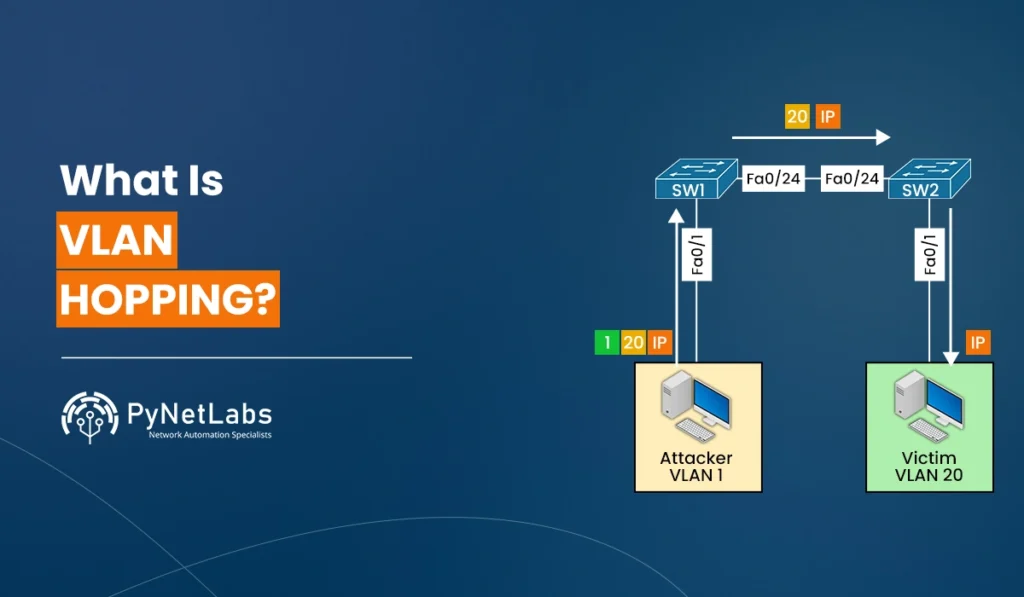



VLAN Hopping is a network attack technique which allows traffic to enter a virtual LAN that it should not be able to access. It takes advantage of a switch misconfiguration or a VLAN tag handler, compromising the separation of network segments. The two main techniques are switch spoofing and double tagging.
For businesses, network segmentation is useful only when its boundaries are enforced correctly. A vulnerable switch port can weaken the separation between employee devices, guest connections, and sensitive systems. A vulnerable switch port can weaken that design and expose resources to unauthorized traffic.
The first step to understanding the attack is to understand how switches manage access ports, trunk links, and native VLANs. In this blog we will discuss the mechanics, compare both methods, and detail some of the practical steps you can take to provide better VLAN security.
What Is VLAN Hopping?
VLAN Hopping is a network attack in which an attacker attempts to send or access traffic across different Virtual Local Area Networks (VLANs) without proper authorisation. It exploits weaknesses in switch configurations or VLAN tagging to bypass network segmentation and reach devices or data in another VLAN.
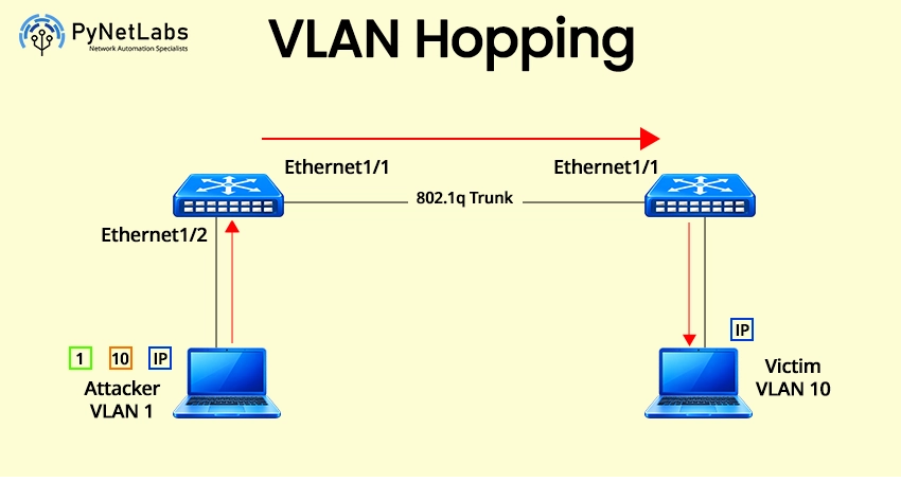
VLAN Hopping typically occurs through two methods: switch spoofing and double tagging. In switch spoofing, an attacker impersonates a switch to negotiate a trunk link, while double tagging involves adding two VLAN tags to a frame to bypass VLAN separation under specific conditions. Proper switch configuration and VLAN security controls help prevent these attacks.
Want to Strengthen Your Networking Skills?
Learn VLANs, routing, switching, and network security with practical CCNA training.

How VLANs Keep Traffic Separate?
A VLAN creates a separate Layer 2 broadcast domain within a switched network. For example, finance computers and guest devices can connect to the same physical switching infrastructure while belonging to different logical networks.
Three terms are important to understanding VLAN separation:
- Access port: Typically connects with an endpoint and one data VLAN. One of the common exception configurations is for voice VLANs.
- Trunk Port: A trunk port is used to transport traffic from one or more VLANs, typically between switches or to an access point or hypervisor.
- Native VLAN: An 802.1Q trunk with untagged native frames specifies the VLAN associated with untagged frames.
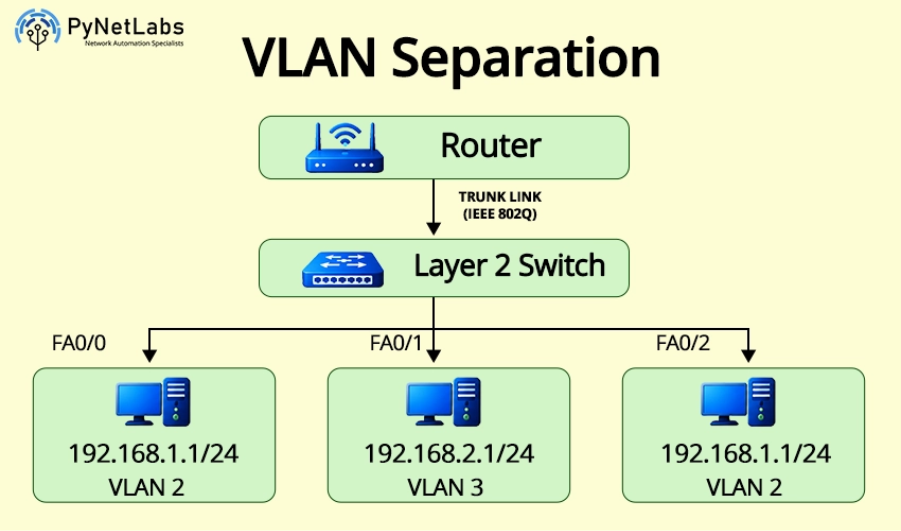
Most traffic carried over an 802.1Q trunk includes a VLAN tag that identifies its VLAN. Native-VLAN handling is an important factor in the classic double-tagging attack.
VLAN Hopping Prevention: Two Main Attack Methods
The two main VLAN Hopping types target different weaknesses. Switch spoofing abuses trunk negotiation; double tagging exploits how VLAN tags are processed.
| Comparison | Switch Spoofing | Double Tagging |
| Main weakness | An endpoint-facing port can negotiate a trunk | Vulnerable handling of stacked tags and untagged native VLAN traffic |
| Attacker’s approach | Pretends to be a switch | Sends a frame containing two VLAN tags |
| Key condition | Trunk negotiation accepts the attacker | Classic setup places the attacker in the trunk’s native VLAN |
| Potential reach | VLANs permitted on the negotiated trunk | A target VLAN reachable through the vulnerable path |
| Traffic direction | Can support two-way communication | Typically one-way |
| Main defenses | Fixed access mode and disabled negotiation | Unused native VLAN and supported native VLAN tagging |
1. Switch Spoofing
Switch spoofing is an attack in which an intruder’s device appears to be a switch and tricks an connected port into acting as a trunk.
DTP (Dynamic Trunking Protocol) can be used to negotiate trunk formation on Cisco equipment that supports the feature. An endpoint-facing port left in a compatible dynamic mode may accept that negotiation.
Once the link becomes a trunk, the attacker can send traffic tagged for VLANs allowed on it. This does not necessarily mean that all of the VLANS are exposed throughout the company, but a very wide list of allowed VLANs will have a greater reach.
The underlying configuration weakness is allowing an untrusted endpoint to influence the port’s role.
2. Double Tagging
Double tagging is a technique that involves an Ethernet frame with two VLAN tags. The outer tag and the classic vulnerable configuration’s native VLAN are the same, while the inner tag represents the target VLAN.
The process is as follows:
1. The attacker tags a frame on the native VLAN with two tags.
2. The first switch removes the outer tag and passes it over a trunk as VLAN traffic, leaving the inner tag intact.
3. The inner tag is exposed.
4. The switch downstream to it reads that tag and forwards the frame within the target VLAN.
Unlike switch spoofing, this technique does not require the attacker to negotiate a trunk. Its success depends on the trunk configuration, the switches’ tag-processing behaviour, and the attacker being able to send traffic from the relevant VLAN.
In classic (one-way) double tagging, there is no matching return path. It should not, therefore, be characterized as granting an attacker an interactive session or access to all traffic on the target system.
What Damage Can a VLAN Hopping Attack Cause?
If the VLAN Hopping attack is successful, the attacker can move the unauthorized traffic near the systems that the network segmentation was designed to keep out.
If the method is used, and the other defenses are in place, the consequences may be:
- Internal Services Exposed: Applications can be exposed to traffic from devices that should not be exposed to them.
- Further Attacks: Broader connectivity can lead to opportunities to attack vulnerable services.
- Traffic Injection: Frames can get to another segment even when there is no active return path.
- Weakened Isolation: Sensitive workloads can be accessed beyond their intended trust boundary.
Access to a VLAN does not automatically enable or bypass application authentication or encrypted connections. The damage will vary based on the systems that can be accessed and how they are secured.
VLAN Hopping Prevention: Controls That Address the Cause
Preventing VLAN Hopping requires secure switch configurations that restrict unauthorised trunk negotiation and control how VLAN tags are processed. Implementing access-port settings, limiting VLANs on trunks, and securing native VLANs helps maintain network segmentation and protect sensitive resources.
1. Set Endpoint Ports to Access Mode
Explicitly set up normal endpoint facing ports as access ports. Switchport mode access does not allow the port to be a trunk on supported Cisco switches.
Assign the intended data VLAN and verify the operational mode afterward. Review special cases, such as phones and wireless access points, according to their actual requirements.
2. Disable Unnecessary Trunk Negotiation
Configure legitimate trunks deliberately and disable DTP negotiation where supported. This is typically accomplished with switchport nonegotiate. Treat port mode and negotiation as separate checks.
A fixed trunk with no negotiation enabled still has multiple VLANs running on it, it has to be attached to a trusted device. These controls address switch spoofing. Double tagging requires attention to native VLAN handling as well.
3. Reserve an Unused Native VLAN
Ideally use a dedicated native VLAN without normal endpoint assignments or production workloads. Ensure that its configuration is the same on both ends of each trunk.
If users are still on the new native VLAN, changing the VLAN number of VLAN 1 is not enough. The protection is not about making the VLAN number hard to guess, it’s about getting rid of devices that are accessible to attackers in that role.
4. Limit VLANs on Every Trunk
Allow only the VLANs that each trunk requires. The employee and voice VLANs should not be automatically carried on an uplink that is used to support employee and voice networks.
Check for equipment and service retirements and review allowed lists. This limits unnecessary exposure, although it does not replace the other controls.
5. Control Network Admission and Traffic
Implement 802.1X authentication as needed to limit network access to authorized devices or users. Turn off unused ports and physically secure available network connections.
Implement communication policies using appropriate access control lists and firewalls. These offer extra protection, and the proper configuration of the switch keeps the VLAN boundary intact.
How to Detect and Verify VLAN Hopping Risks?
Begin with configuration reviews, then use monitoring to investigate unexpected behaviour. Useful checks include:
- Ports becoming trunks without an approved change.
- DTP traffic on connections intended only for endpoints.
- Native VLAN mismatches between neighboring switches.
- Changes that expand trunk allowed-VLAN lists.
- Unexpected stacked tags at endpoint-facing ports.
Stacked tags alone do not prove an attack; legitimate provider networks can use Q-in-Q encapsulation. Examine them in relation to the port’s anticipated function.
During an authorised security assessment, verify that a test endpoint cannot negotiate an unauthorised trunk or deliver traffic into prohibited VLANs. Where possible, confirm actual forwarding behaviour with packet captures rather than relying only on configuration output.
Is VLAN Hopping Still Relevant?
The risk depends on the deployed configuration and switching implementation. Classic switch-spoofing and double-tagging paths can be mitigated by fixed endpoint-port roles, restricted trunk VLAN lists, and secure native-VLAN handling. The exact protections available vary by platform.
Configuration drift remains a concern. A replacement switch, restored backup, or reused configuration template can reintroduce settings that were previously hardened. Regular audits help ensure that controls remain effective.
Conclusion
VLAN Hopping exposes weaknesses in how switches enforce network separation. Switch spoofing exploits the trunk negotiation and double tagging exploits the native VLAN and tag processing vulnerability. Effective prevention combines explicit port roles, controlled trunks, unused native VLANs, and supported native VLAN tagging. Ensure those boundaries remain reliable with network changes by implementing network authentication, traffic policies and regular verification.
Frequently Asked Questions
Q1 Can a VLAN Hopping Attack Cross Any VLAN?
No. The attacker can only gain access to VLANs that the network configuration allows to be accessed via a vulnerable trunking or tagging configuration. What is reachable is limited by good trunk restrictions and firewall policies.
Q2 Is VLAN Hopping Prevention Being Replaced by a Firewall?
No. Traffic between routed networks is managed by a firewall. VLAN Hopping prevention is the protection of the switching layer below. Use both.
Q3 Will Changing the Native VLAN Stop VLAN Hopping?
An unused native VLAN is an important step to avoid double tagging, but it’s not the only one. Also, disable dynamic trunking, statically configure ports and limit VLANs on trunks.
Q4 Is VLAN 1 a Bad Idea to Use?
VLAN 1 is not a broken VLAN, but it is a risk-free VLAN when used for normal users, management traffic or as the reachable native VLAN on a trunk. Many secure designs keep it and redirect production traffic to other locations.