




Introduction
Every time you send an email, stream a video, or open a website, data travels across multiple networks before reaching its destination. But how does it always find the best path? The answer lies in Routing Protocols, the intelligent mechanisms that enable routers to exchange information and make efficient forwarding decisions across complex networks.
In this blog, we’ll explore Routing Protocols and their various types, explaining how they work, why they are essential, and where each protocol is used. Whether you’re preparing for CCNA or CCNP certification, a networking interview, or building a strong networking foundation, understanding Routing Protocols is a fundamental skill for every network professional.
What are Routing Protocols?
Routing Protocols are a set of rules that enable routers to exchange network information and determine the most efficient path for forwarding data between different networks. They automatically learn, update, and maintain routing information, allowing networks to adapt to changes without requiring constant manual configuration.
That is why each routing protocol has its own strategy for information collection and distribution. This is vital because the state of a network can change frequently due to various factors: devices can sometimes drop the connection, routing paths can disappear, or new paths can appear. Routing protocols assist various types of routers in getting the latest information to improve routing decisions on packets.
Routing protocol selection is dependent on the nature of a given network, including its configurations.
Now, let us discuss the various types of routing protocols and their uses.
Types Of Routing Protocols
There are several types of Routing Protocols, each designed to address different networking needs and environments. The main categories of Routing Protocols include Static Routing Protocol, Default Routing Protocol, and Dynamic Routing Protocol.
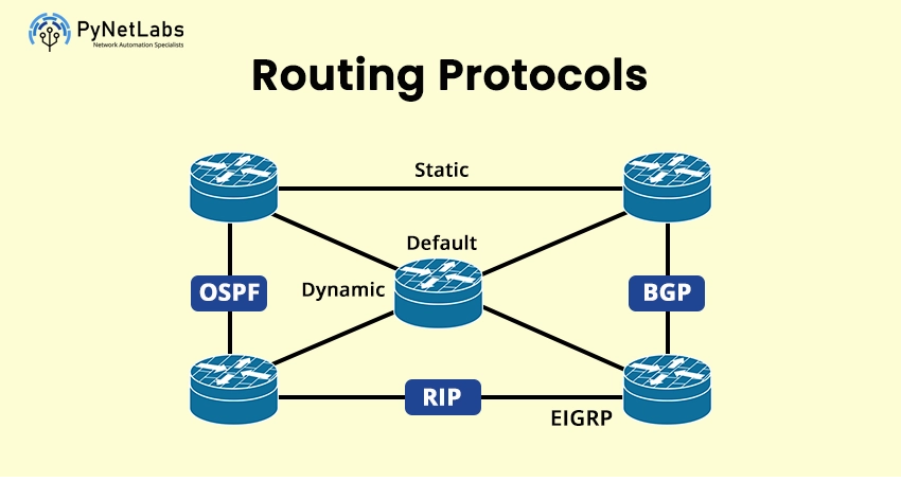
1. Static Routing Protocol
Static routing is where a network administrator configures the routes. This means that the data packets follow predetermined paths that are fixed and cannot be changed by anyone apart from the administrator. It is like trying to drive with a map that does not change even when you are in a different area.
Static routing is easy and requires little processing power it is a good choice for small networks wherein the traffic pattern is unlikely to be updated frequently. Static routes can result in communication breakdowns or poor routing if, for instance, a link goes down or the network topology changes. In case any problem arises, it has to be solved by the network administrator, not by a given configuration; this might be a problem with large or complicated networks.
2. Default Routing Protocol
A default routing protocol is a simplified method of forwarding all the packets to a single exit point if the destination is unknown.
The default routing is most beneficial when used in stub networks, which refer to networks with only one possible route. In larger networks, it can be disadvantageous to set up a default route because data may be forwarded in the wrong path if there is no specific route available.
Build advanced routing skills for modern networks with OSPF BGP Combo Training – Register to know more!
3. Dynamic Routing Protocol
Dynamic Routing Protocols automatically learn, update, and maintain routing information based on changing network conditions. Unlike static routing, they enable routers to exchange routing information and select the best available path without requiring manual configuration. This makes them ideal for medium and large networks where routes change frequently.
Routers continuously share route updates to adapt to changes such as network traffic, link failures, or the addition of network devices. This allows the network to maintain optimal performance, improve reliability, and automatically choose the most efficient route for data transmission. Popular dynamic Routing Protocols include RIP, OSPF, EIGRP, and BGP.
Dynamic routing can be thought of as a GPS system for your data: it always determines the most optimal routes to follow based on information that is real-time. This capability can help the networks stay at their peak performance regardless of the environment that surrounds them.
Dynamic protocols are further classified into a set of Routing Protocols. Let’s discuss all these protocols in detail.
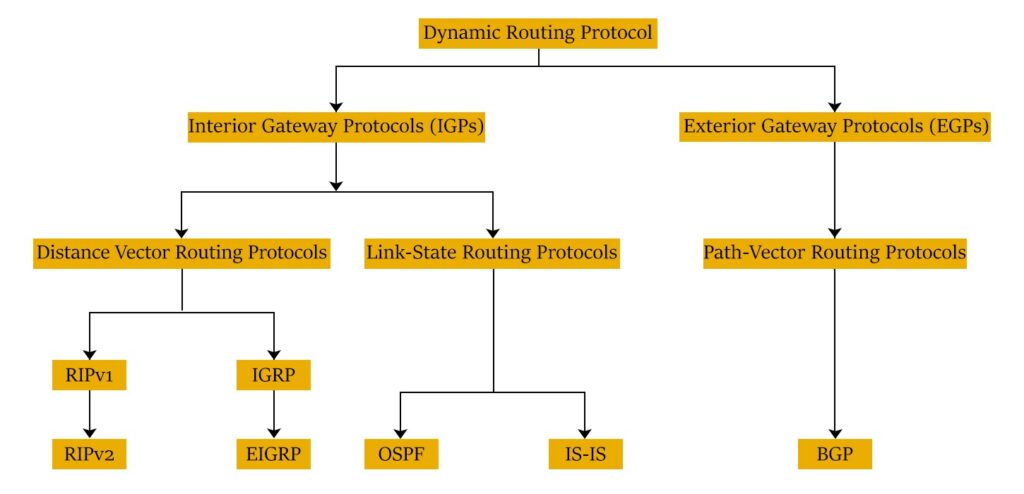
Dynamic routing protocols are further classified into two main categories. These are:
3.1. Interior Gateway Protocols (IGP)
These protocols operate within a single organization or administrative domain. They manage routing within internal networks. Examples of IGP include distance vector routing protocols and link-state routing protocols.
Types of Interior Gateway Protocol (IGP)
Interior Gateway Protocols (IGPs) are Routing Protocols used to exchange routing information within a single Autonomous System (AS). They help routers identify the most efficient paths and ensure reliable communication across an internal network. The following are the main types of IGPs:
3.1.1. Distance Vector Routing Protocols
These protocols are used to measure the distance of the destination in order to define the best path. Each router has its routing table with its immediate neighbors’ information to decide on the best route possible.
How It Works: Distance vector protocols are characterized by the sending of updates after regular intervals. Still, they give information about distance (generally in terms of hop count) to reach different network destinations. Afterwards, each router adjusts its routing table to its current status according to the information obtained.
Advantages: They are simple to implement and configure, making them suitable for small networks.
Disadvantages: They can consume more bandwidth due to constant updates and are slower to react to changes in the network.
Three popular distance vector routing protocols are:
- RIP (Routing Information Protocol): RIP is one of the oldest distance vector protocols. It uses the hop count as the metric to determine the best path. RIP is simple but not very scalable, making it suitable for small networks.
- RIPng (RIP Next Generation): An updated version of RIP designed for IPv6 networks.
- IGRP (Interior Gateway Routing Protocol): Developed by Cisco, IGRP uses a composite metric that includes factors like bandwidth, delay, and reliability. It is more complex than RIP but offers better performance.
- EIGRP (Enhanced Interior Gateway Routing Protocol): An advanced version of IGRP, EIGRP uses a diffusing update algorithm (DUAL) to find the best path. It is highly efficient and scalable, making it suitable for large networks.
3.1.2. Link-State Routing Protocols
These protocols maintain the entire network connectivity map, helping routers to make more informed decisions on routing. Routers with Link-state protocol send information only about directly connected links in the entire network to every other router.
How It Works: Every router forms a link-state packet (LSP) containing information about neighbors and the state of the links. This packet is then sent to all other routers, which makes it possible to develop the entire network map.
Advantages: They can quickly adapt to network changes and provide more efficient routing.
Disadvantages: Compared to distance vector routing protocols, link-state routing protocols have certain drawbacks, including increased configuration complexity, as well as higher memory and data processing requirements.
Two popular link-state routing protocols are:
- OSPF (Open Shortest Path First): It is one of the most popular link-state protocols today. It functions within an AS (Autonomous system). OSPF groups the networks hierarchically for better management and tracking.
- OSPF uses a cost-based metric based on link transmission speed and is, therefore, capable of selecting the least cost path.
- It supports large networks and is scalable because of the concept of layering, i.e., hierarchical structure.
- OSPF sends updates only when there is some change, so the bandwidth utilization is minimized.
- IS-IS (Intermediate System to Intermediate System): This protocol is very much like OSPF and it also uses a link-state technique. It was originally developed for local ISO networks but is now modified for Internet use.
- IS-IS is easier to utilize and can be used in IP as well as non-IP networks.
- On the same note, it optimized for large complex networks, though not as popular as OSPF.
3.2. Exterior Gateway Protocols (EGP)
These protocols are used for communication between two different organizations or between different administrative domains. They manage the flow of data between various networks. The most important example of the EGP is the border gateway protocol (BGP).
Types of Exterior Gateway Protocols (EGPs)
3.2.1. Path Vector Routing Protocols
Path Vector protocols keep track of the paths that data packets take from one node to the other in a network. This type is particularly suitable for interdomain routing (for example, in the case of multiple autonomous systems).
BGP (Border Gateway Protocol): BGP stands for Border Gateway Protocol and is used in the exchanging of information relating to routing between different networks. It finds out the optimal routes through which data can travel based on factors such as policies and characteristics of the path.
It heavily relies on “peers” or “neighbors” that assist in the exchange of routing information that further allows networks to address change or occurrence of outages in a real time.
- It is responsible for keeping a record of the path information dynamically with the changes in the network topologies.
- It makes use of attributes (AS-path or next hop) to regulate routing policies and to choose the best paths.
All the routing protocols we have discussed serve different or sometimes overlapping purposes. Understanding different types of routing protocols is crucial for selecting the right one based on your specific needs.
Conclusion
Understanding Routing Protocols is essential for building efficient, scalable, and reliable networks. Whether using static routing for simple environments or dynamic protocols such as RIP, OSPF, EIGRP, and BGP for larger deployments, each serves a specific purpose. By choosing the right routing protocol for your network, you can improve performance, ensure faster convergence, and maintain seamless communication across modern enterprise networks.
Frequently Asked Questions
Q1. What are the 3 types of routing protocols?
The three main types of routing protocols are:
- Static Routing Protocol
- Default Routing Protocol
- Dynamic Routing Protocol
Q2. What is routing and its protocol?
Routing is the process of determining a path for packets to travel from a source network to a destination network. Routing protocols such as OSPF, RIP, EIGRP, and BGP allow routers to exchange routing information and make routing decisions.
Q3. What are layer 3 routing protocols?
Layer 3 protocols are the protocols that operate on layer 3 of the OSI model and are mainly responsible for determining the best path. Some examples of layer three protocols are RIP, OSPF, EIGRP, BGP, etc.
Q4. What is RIP, OSPF, and BGP?
RIP, OSPF, and BGP are routing protocols. OSPF and RIP are types of IGP (Interior gateway protocols), whereas BGP is a type of EGP (Exterior gateway protocols).
Q5. What are Switching Protocols?
Switching protocols are network protocols used to manage data traffic within a local area network (LAN) by efficiently forwarding data between devices. Common switching protocols include Spanning Tree Protocol (STP) to prevent loops, VLAN Trunking Protocol (VTP) for VLAN management, and Link Aggregation Control Protocol (LACP) for combining multiple links.