
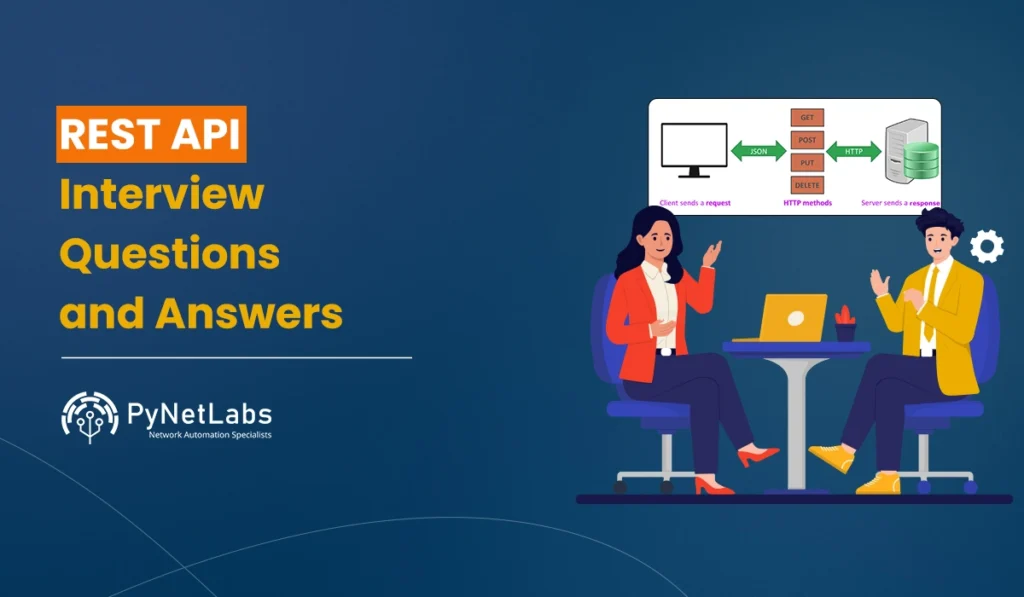



You have worked with APIs for a long time and then appear in the interview and asked “What’s the difference between PUT and PATCH?” and your mind goes blank. It happens more often as many candidates use REST every day but struggle to explain it out loud. Others know every definition and freeze when the question turns into a real problem, like a customer getting charged twice.
In this blog, we have covered the most asked 25 REST API interview questions with answers. We have tried to cover both beginners and professionals as there are 10 for beginners, 10 for experienced developers, and 5 scenario-based questions.
Let’s start by first covering beginner REST API interview questions and answers.
REST API Interview Questions and Answers: Beginner-Level
Q1. What is a REST API?
REST API is an application which works with HTTP and follows REST principles . It usually exposes resources like users, products, orders or payments.
For example:
GET /products/25
could return product 25.
The response is usually JSON, although REST doesn’t require JSON.
REST is an architecture style. It’s not a programming language or a protocol.
Learn how REST APIs are used in real-world network automation. Build practical skills with a Network Automation course.

Q2. What are the main REST constraints?
REST defines six architectural constraints:
- Client-server
- Stateless
- Cacheable
- Uniform interface
- Layered system
- Code on demand, which is optional
Q3. What is a resource in a REST API?
A resource is something you need to get to or manage via an API. It could be a customer, employee, product, order, invoice, or just about any other application data.
For example:
/customers/50
identifies a customer resource.
The server sends back a representation of that resource to the client. One common format for that representation is JSON.
4. Which HTTP methods are commonly used in REST APIs?
The five methods you will see most often are:
| Method | Usually Used For |
| GET | Reading data |
| POST | Creating a resource or starting an operation |
| PUT | Replacing a resource |
| PATCH | Updating part of a resource |
| DELETE | Removing a resource |
The method should describe what the request is trying to do.
For example, GET /orders/100 should retrieve the order. It should not change it.
Q5. What is the difference between PUT and PATCH?
Both can update data, but usually describe different types of updates.
PUT normally replaces the current representation of a resource.
PATCH changes just part of it.
Suppose this user exists:
{“name”:”Aman”,”city”:”Delhi”,”age”:27}
If you only want to change the city, PATCH can just send the new city. The exact behavior still needs to be defined in the contract with the API.
Q6. What does stateless mean in REST?
Stateless means that the server should not need information from a previous request to understand the current request.
Suppose a client performs three API calls. Request three must include all information needed to process request three. The request should carry along details, parameters, and all other required information. This also makes it easier to distribute requests across multiple servers.
Q7. Which HTTP status codes should you know for a REST API interview?
You do not need to memorize every HTTP status code. These appear more often:
| Code | Meaning |
| 200 | Request succeeded |
| 201 | Resource created |
| 204 | Success, but no response body |
| 400 | Bad request |
| 401 | Authentication is missing or invalid |
| 403 | User is not allowed to perform the action |
| 404 | Resource not found |
| 409 | Request conflicts with the current state |
| 429 | Too many requests |
| 500 | Server error |
Interviewers may also give you a situation and ask which code you would return.
Q8. What is the difference between authentication and authorization?
Authentication asks: Who are you?
Authorization asks: What are you allowed to do?
The user may login successfully, but may not have permission to delete another user’s account.
Authentication succeeded but authorization should prevent the action.
Note: APIs may use sessions or API keys or OAuth or access tokens or other means for authentication.
Q9. What is the difference between REST and SOAP?
| REST | SOAP |
| Architectural style | Messaging protocol |
| Often uses JSON | Usually uses XML |
| Common in web and mobile APIs | Common in some enterprise integrations |
| Flexible design | More rigid standards |
You should not say REST is always the best. SOAP still makes sense where strict contracts or specific enterprise standards are required.
Q10. What is the difference between a URI, resource, and endpoint?
A Resource is an Entity or Data Object Presented in an API (e.g., Customer, Order, and Product).
URI (Uniform Resource Identifier) will be used to Uniquely Identify each Resource presented through the API.
For example:
/customers/52
An Endpoint refers to the API Access Point which is Defined By both an HTTP Method and a URI.
For example:
GET /customers/52
REST API Interview Questions and Answers: Advanced-Level
Q11. What is idempotency in REST APIs?
An operation is idempotent if that same request can be repeated any number of times with the same intended effect as that of a single request.
PUT, DELETE and safe HTTP methods are defined in HTTP semantics as idempotent. POST is not idempotent by default.
This is important when requests are retried.
If the network is down after an update, you can usually repeat an idempotent operation without performing the action twice.
Q12. How would you secure a REST API?
Start with HTTPS.
Consider authentication and authorization separately. You should not be able to login and have access to every resource automatically.
You must also validate input, protect secrets, limit requests, not show sensitive information in errors and log security related events.
The most important thing is to check the permission on the server. Never rely on the front end to enforce user access.
Q13. How do you version a REST API?
Versioning is needed when a change would break existing clients.
A simple approach is:
/api/v1/users
and later:
/api/v2/users
Some APIs version through headers instead. Every API is different, so there’s no universal solution.
Explain the trade-off for a senior level position interview. URI versions are easy to view and try. Header versions are less visible but keep URLs cleaner.
Current senior interview material specifically treats versioning as a design decision rather than a question with one correct answer.
Q14. How does pagination work in REST APIs?
Pagination breaks a large result into smaller responses.
A simple endpoint could use:
GET /products?page=3&limit=20
This is very good for many purposes.
For large and frequently changing datasets, cursor pagination can be safer. If records are added or deleted when somebody navigates between pages, offset-based pagination may skip or repeat results.
It’s the right decision based on the data and what clients do with it.
Q15. What is rate limiting?
Rate limiting restricts the number of requests a client can make over a time period.
For example an API could accept 100 requests per minute.
Once the client crosses the limit, the API can return:
429 Too Many Requests
Rate limits are in place to prevent abuse of services, buggy clients and sudden spikes. They can also prevent a single customer from consuming resources needed by all other customers.
Q16. How does caching work in REST APIs?
Caching allows a previously generated response to be reused instead of doing the same work again.
Suppose product details rarely change. The client or an intermediate cache may reuse that response for a set period.
HTTP provides mechanisms such as:
Cache-Control
and
ETag
With an ETag, a client can check whether a resource changed before downloading the full representation again.
Caching can reduce latency, bandwidth use, and server load.
Q17. How should an API return errors?
A good error response should help the caller understand what failed.
Returning only:
500 Something went wrong
is rarely useful.
The response should have the correct HTTP status and a consistent body that may include an error type, message, field information, or another safe identifier.
Do not send stack traces or sensitive server details to clients.
Q18. What is CORS?
CORS full form is Cross-Origin Resource Sharing.
Browsers normally restrict JavaScript from making requests to a different origin unless the target server allows it.
For example, a frontend running at:
app.example.com
may call:
api.example.com
The API needs suitable CORS headers.
This is why a request can work in Postman and fail in a browser. CORS is enforced by browsers, and some cross-origin requests require a preflight request first.
Q19. What is HATEOAS?
HATEOAS stands for Hypermedia as the Engine of Application State.
The basic idea is that an API response can contain links telling a client what it can do next.
For example, an order response could include links for:
cancel
payment
invoice
It is part of REST’s architectural approach, but many production APIs do not implement HATEOAS fully.
Q20. REST vs GraphQL vs gRPC: when would you use each?
There is no automatic winner.
REST is a good match for many public APIs and resource-centric applications.
GraphQL is a good choice when your clients need different combinations of related data and want more control over the fields returned.
gRPC is often a consideration for internal service-to-service communication if you care about typed contracts, streaming or efficient binary communication.
Your answer should begin with requirements, not technology preference.
Q21. A Payment API timeout. The client does not know if the payment was successful. What should happen if it retries?
This is a question of idempotency.
The client may send the payment request along with a unique idempotency key.
That key is stored with the result in the server. If the same request with the same key comes in again, it will return the existing result and not charge the customer again.
You can’t just disable the payment button on the frontend as retries can happen for many reasons other than the UI.
Q22. Your REST API works in Postman but fails in the browser. What would you look for?
Check the browser developer tools first.
If the request is being blocked before your application can use the response, CORS is an obvious place to investigate.
Check:
- Allowed origin
- Allowed methods
- Allowed headers
- Credentials configuration
- Preflight response
Postman does not follow browser same-origin restrictions in the same way. That makes “works in Postman but not in the browser” a common CORS interview scenario.
Q23. An endpoint has millions of records. How would you design it?
First, add pagination.
For a large dataset that changes frequently, you should consider cursor pagination with a stable sorting field. Also give clients useful filters so they do not request data they never need.
After that, check database indexes, response size, caching, query cost, and timeouts. Large exports may be better handled as background jobs instead of normal synchronous API responses.
Q24. You want to rename a field but old mobile apps still rely on it. What would you do?
Don’t take out the old field all at once.
Add the new field first and keep the old one working while clients migrate.
Mark the old field as deprecated. Track ongoing client usage.
If the required change cannot remain compatible, introduce a new version of the API and give clients enough time to migrate.
Not every user will upgrade immediately once a mobile app is installed on someone’s phone.
Q25. Your API suddenly receives 10 times the normal traffic. What would you do?
First, you want to know which part of the system is under pressure. It could be application servers, database, third party service or one expensive endpoint.
Then use the tools that fit the real bottleneck. This could mean caching, rate limits, database tuning, queues, load balancing or more capacity.
Latency, errors, request volume, and resource usage should also be checked.
The point of the interview is that you can’t solve every traffic problem by saying, “add more servers.”
Conclusion
In interviews, many candidates can recite the basic definition of REST terminologies. Fewer candidates can take a user-facing API, break it down, and explain its functionality.
To differentiate yourself from the competition, familiarize yourself with the fundamentals of REST API. Also, knowing the rationale behind various design choices will help you construct better answers.
While preparing these REST API interview questions and answers, do not try to memorize every sentence. Pick a question, explain it in your own words, and add a simple example.