
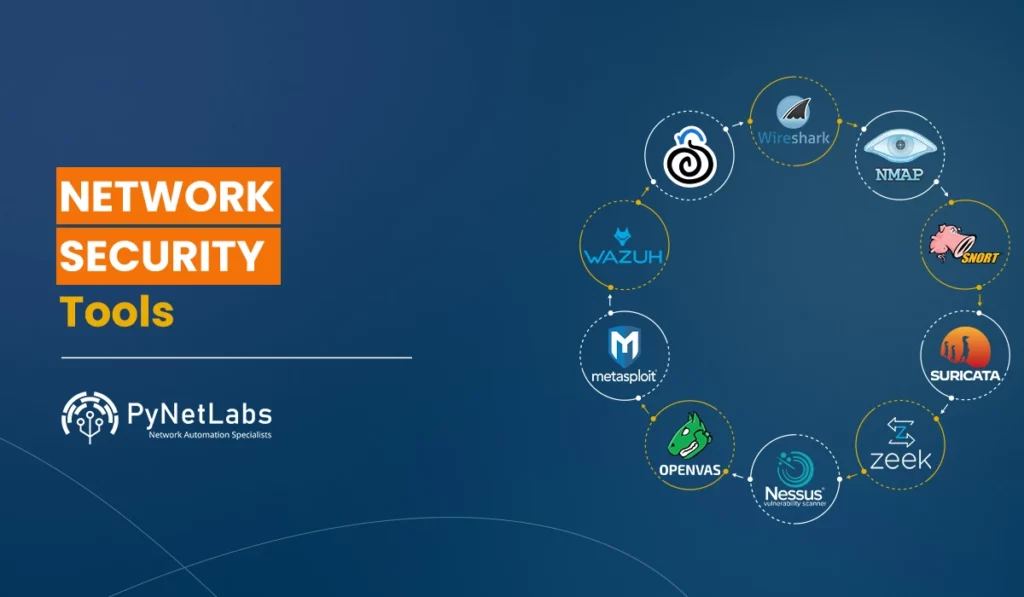


Network security tools help security teams understand what exactly is happening inside the network, finding weak points, and taking action before small problems turn into serious threats.
For network engineers, the tools are helpful for a variety of purposes including troubleshooting, traffic analysis, security checks, compliance checks as well as incident management. The top network security tools provide insight into the devices, users, ports, packets, logs, threats, as well as errors in configurations.
In this blog we are going to discuss the network security tools for network engineers who need to enhance their practical skills.
What is Network Security?
Network security is the process of securing networks, devices connected to them, applications, data, and networks from misuse, unauthorized access as well as disruptions or attacks. It’s not just limited to a single firewall or security product. It’s a layered approach that revolves around policies, processes, people, and technology.
Common network security techniques include:
| Technique | Application | Benefit |
| Access control | Allows only approved users, devices, and systems. | Reduces unauthorized access. |
| Firewall filtering | Allows or blocks traffic based on rules. | Controls traffic between networks. |
| IDS/IPS | Detects or blocks suspicious network activity. | Helps identify and stop attacks. |
| Anomaly detection | Finds traffic or behavior that looks unusual. | Helps catch unknown threats. |
| Application security | Protects applications, APIs, and web services. | Reduces app-level risk. |
| Data loss prevention | Monitors sensitive data movement. | Helps prevent data leaks. |
| Email security | Filters phishing, malware, and harmful links. | Protects users from common attacks. |
| SIEM and logging | Collects and correlates security events. | Improves investigation and response. |
| Vulnerability management | Finds weak systems and missing patches. | Helps teams fix risk before attackers use it. |
Best Network Security Tools for Network Engineers
Network security tools are software platforms, scanners, analyzers and monitoring systems that are used to examine traffic, identify assets, scan vulnerabilities, detect threats, and examine logs. They give network engineers the proof they need in order to secure a network instead of making guesses.
Let’s discuss each tool in detail along with their best use cases.
1. Wireshark
Wireshark is among the most effective network security tools for packet level analysis. It allows engineers to capture and analyze live traffic, look up the protocol’s details, and comprehend what’s exactly moving across the wire.
Security professionals employ Wireshark to examine suspicious activity, handshakes that failed, problems associated with DNS, retransmissions, clear-text credentials, as well as unusual connections. Network engineers employ it to establish whether there is a problem with the network, application, or even the endpoint.
Best For: It is ideal for analyzing packets, troubleshooting protocols learning, as well as traffic analysis or inspection.
2. Nmap
Nmap also known as Network Mapper is an open-source tool that is popular for network discovery and for security auditing. It assists engineers in finding live hosts, open ports, operating system hints, as well as attack surfaces that are exposed.
With its basic scan you can identify forgotten services, risky ports or devices that should not be accessible through a particular network segment. For those who are new to network security filed, Nmap can be a good tool to learn the way attackers and defenders examine vulnerable systems.
Best for: It is Ideal for Port scanning, assets discovery, service detection and auditing security.
3. Snort
Snort is an open-source intrusion detection and prevention network security tool. It is a great tool for understanding the way that signature-based detection works.
Security teams can make use of it to identify scans, malware behaviour, exploits, policy violations and other suspicious activity. It can also assist network engineers to understand what type of traffic is passing through important points of the network.
Best for: It is usually the best choice for IDS/IPS learning, packet logging and signature-based threat detection.
4. Suricata
Suricata is a high-performance network IDS, IPS, and network security monitoring engine. With this tool, you can do advanced packet inspection, protocol parsing, extraction of files, as well as structured logs.
Suricata can be useful in situations that require teams to perform robust traffic inspection at a large scale. It can run in conjunction with rules, generate specific events, and assist with the inline prevention when properly deployed. Many teams utilize Suricata logs in conjunction with SIEM tools to gain better visibility.
Best for: It is one the best choices for IDS/IPS, high-speed inspection as well as detection of network threats.
5. Zeek
Zeek is not a traditional alert-only IDS. It’s a security monitor framework that generates extensive logs about network activity. The logs may include the user connections, DNS queries, HTTP activity, SSL details, files, and other relevant metadata.
Zeek is a powerful tool because it provides an explanation. Instead of just saying that something took place, it assists analysts in understanding the ways in which systems communicate. This makes it extremely efficient for threat detection or incident response as well as longer-term visibility of networks.
Best For: It is suitable for network visibility, threat hunting, metadata logging, and incident investigation.
6. Nessus
Nessus is known as a popular vulnerability scanning tool. It assists teams in scanning servers, cloud assets, network devices and services for a variety of known vulnerabilities, patch issues, weak configurations, and issues regarding compliance.
For security engineers, Nessus helps prioritize what must be addressed first. For network engineers, it could identify outdated firmware, exposed protocols, services that are risky, and device configurations that are weak. It also helps with audit preparation and regular security tests.
Best For: It is one the network security tools for network engineers to scan vulnerability, check compliance, and prioritizes patches.
7. OpenVAS / Greenbone Community Edition
OpenVAS is a free vulnerability scanner that is part of the Greenbone ecosystem. With this tool, you can perform authenticated as well as unauthenticated checks. It is commonly employed by teams who want scanning for free.
OpenVAS could require more setup than other commercial tools, however it’s a great tool for internal assessments, labs, and for practical learning. It assists engineers to understand how vulnerability scanners operate and also how scan results must be analyzed carefully prior to making any decisions.
Best For: It is most suitable for vulnerability scanning with open-source software, internal audits, as well as Security labs.
8. Metasploit Framework
Metasploit Framework is a modular penetration testing platform. It helps security professionals in determining whether vulnerabilities can be exploited. It is best to use it with explicit permission and proper scope.
For security engineers, Metasploit is mainly useful for validation. A scanner might say that the system is insecure however exploitation testing could demonstrate the actual consequences.
For network engineers, it can help to explain why exposed services, inadequate credentials, and a lack of patches can be serious problems.
Best For: It is mainly ideal for penetration testing, exploit validation and red team learning.
9. Wazuh
Wazuh is a free as well as open-source security platform that includes SIEM as well as XDR capabilities. It collects data, monitor devices, identify suspicious activity, monitor endpoints, and assist teams in handling alerts.
Wazuh is useful in situations where router logs, firewall logs, server events and alerts from endpoints must be seen together. It assists teams in moving from isolated alerts into a more integrated security perspective. It also assists with the monitoring of compliance and file integrity checks.
Best For: It is Ideal for SIEM, XDR, Log analysis and monitoring of network devices.
10. Security Onion
Security Onion is a free and open platform that is mainly designed for defenders. With this tool you can get information about network, host, intrusion detection. It also includes packet capture, log management as well as case management.
Security Onion is more than one tool. It’s a complete monitoring system that lets teams look over alerts, examine the data in packets such as search logs, and handle investigations. For learners, it’s one of the best methods to learn about how a SOC environment functions.
Best For: It is mainly suitable for security monitoring, SOC Labs, packet analysis and even case-management.
How to Choose the Right Network Security Tool
The best tool depends on the problem you need to solve.
- For packet inspection, use Wireshark.
- For open ports and exposed services, use Nmap.
- For intrusion detection and prevention, use Snort or Suricata.
- For deep network visibility, use Zeek.
- For vulnerability scanning, use Nessus or OpenVAS.
- For centralized alerts and logs, use Wazuh or Security Onion.
Beginners should start with Wireshark, Nmap, and one IDS tool. These tools build a strong base in traffic, ports, protocols, and detection. Professionals should learn how tools work together.
For example, Nmap may show an exposed service, Nessus may confirm a vulnerability, Zeek may show suspicious activity, and Wazuh may connect that activity with endpoint logs.
Frequently Asked Questions
Q1. What are the five types of network security?
Ans. The five types of network security are firewalls, IPS, VPNs, wireless security, and antivirus or malware software.
Q2. What are the top 5 EDR tools?
Ans. The top five EDR tools are Palo Alto Networks, Microsoft Defender, SentinelOne Singularity, Cortex XDR, and CrowdStrike Falcon.
Q3. What are the 7 types of security?
Ans. The seven type of security are physical security, network security, endpoint security, application security, cloud security, data security, and human layer security.
Q4. What are all the soc tools?
Ans. SOC tools are security tools used by a Security Operations Center to monitor, detect, investigate, and respond to cyber threats.
Conclusion
Network security tools are crucial for those responsible for safeguarding or running modern networks. They help engineers in analyzing traffic patterns, find assets, detect unusual activity, examine logs, and then respond with better proof instead of guessing.
The most efficient network security tools for network engineers aren’t always the most expensive. Tools such as Wireshark, Nmap, Snort, Suricata, Zeek, OpenVAS, Wazuh, and Security Onion can build strong real-world knowledge. Commercial tools such as Nessus provide scale and reporting.
The goal isn’t to try all tools at the same time. The goal is to know what each tool does, when to use it, and how it helps reduce real network risk.