

Introduction
Every time data moves across a network, it faces risks such as interception, unauthorised access, and manipulation. Network Security Protocols act as the rules that help protect this communication, using encryption, authentication, integrity checks, and access controls. From browsing a website to connecting to a corporate VPN, these protocols work behind the scenes to secure network traffic.
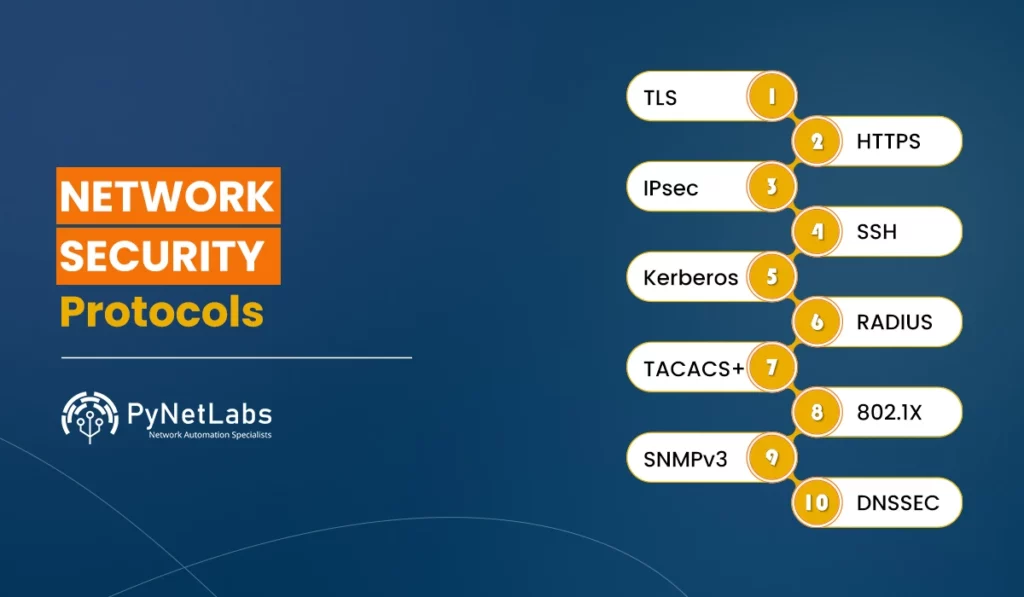
But not every protocol protects a network in the same way. Network Security Protocols can be grouped based on the security function they perform, with examples including TLS, HTTPS, IPsec, SSH, RADIUS, and DNSSEC. In this blog, we will explore their types, examples, key functions, and how they help protect modern networks.
What Are Network Security Protocols?
Network Security Protocols are standardised methods used to secure communication between systems connected through a network. A protocol defines how devices establish trusted connections, authenticate one another, encrypt information, and verify that transmitted data has not been modified.
Security protocols generally provide one or more of these protections:
- Confidentiality
- Authentication
- Integrity
- Access control
- Secure administration
For example Transport Layer Security is designed to keep communications between applications protect against people listening in and tampering with the information. The Cybersecurity and Infrastructure Security Agency currently recommends using Transport Layer Security 1.3 when it is supported. They recommend using strong cryptographic configurations, for Transport Layer Security.
Network Security Protocols List
The following Network Security Protocols list covers some of the protocols network and security engineers are most likely to encounter.
| Protocol | Main Purpose | Common Use |
| TLS | Encryption and authentication | HTTPS, applications, APIs |
| HTTPS | Secure web communication | Websites and web applications |
| IPsec | Network-layer protection | VPNs and site-to-site connections |
| SSH | Secure remote access | Routers, switches, servers |
| Kerberos | Centralised authentication | Enterprise networks |
| RADIUS | Authentication, authorisation and accounting | VPN, Wi-Fi, network access |
| TACACS+ | Device administration and AAA | Routers, switches, firewalls |
| 802.1X | Port-based network access control | Enterprise LAN and Wi-Fi |
| SNMPv3 | Secure network monitoring | Network device management |
| DNSSEC | DNS data authentication | Protecting DNS responses |
These protocols do not replace one another. Instead, they protect different layers and functions within the network.
Types of Network Security Protocols
Network Security Protocols can be broadly grouped according to the primary security function they perform. Some protocols focus on encrypting data, while others provide authentication, access control, secure remote access, network management security, or protection for DNS data. Understanding these categories helps network engineers select the appropriate protocol based on the security requirements of a network or application.
Encryption Protocols
Encryption protocols protect information while it travels between systems. They help prevent unauthorised parties from reading or modifying data transmitted across networks. Common encryption and security protocols include TLS, HTTPS, and IPsec.
Transport Layer Security (TLS)
TLS is one of the most widely used Network Security Protocols. It protects communications between applications by providing encryption, data integrity, and authentication. TLS is commonly used for:
- HTTPS websites
- Web applications
- APIs
- Email services
- Cloud services
- Secure application communication
Secure Sockets Layer (SSL)
You may still come across terms such as SSL certificate or SSL VPN. However, SSL is an older predecessor to TLS and is no longer considered a secure protocol for modern communications. Modern systems should use supported TLS versions rather than the outdated SSL protocols.
HTTPS
HTTPS stands for Hypertext Transfer Protocol Secure. It is essentially HTTP communication protected using TLS. HTTPS helps reduce the risk of attackers intercepting or modifying sensitive information such as:
- Login credentials
- Payment details
- Personal information
- Application data
- Session information
HTTPS also uses digital certificates to help verify the identity of the server to which a user is connecting.
Internet Protocol Security (IPsec)
IPsec is a collection of technologies designed to protect IP communications at the network layer. Unlike TLS, which commonly protects specific application connections, IPsec can protect traffic between hosts, networks, or security gateways.
Typical applications include:
- Site-to-site VPNs
- Remote-access VPNs
- Gateway-to-gateway protection
- Secure communication between networks
IPsec can provide confidentiality, authentication, integrity, and replay protection.
IPsec Example
Suppose a company has offices in Delhi and Mumbai. An IPsec site-to-site VPN can establish an encrypted tunnel between their network gateways. Traffic travelling between the two office networks passes through this protected tunnel rather than travelling across the internet as unprotected IP traffic.
Authentication and Access Control Protocols
Authentication and access control protocols verify the identity of users, devices, or systems and determine whether they should be allowed to access network resources. Four important protocols and frameworks in this category are Kerberos, RADIUS, TACACS+, and 802.1X.
AAA is an important concept associated with several of these protocols. AAA stands for Authentication, Authorisation, and Accounting:
- Authentication: Verifies who you are.
- Authorisation: Determines what you are allowed to do.
- Accounting: Records activities and access information.
Understanding these functions is particularly important when designing enterprise network access controls.
| Protocol | Primary Role | Common Environment |
| Kerberos | User and service authentication | Enterprise domains |
| RADIUS | Centralised AAA | VPN and Wi-Fi |
| TACACS+ | Administrative AAA | Network devices |
| 802.1X | Network access control | LAN and WLAN |
Kerberos
Kerberos is an authentication protocol commonly used in enterprise environments. Instead of repeatedly sending a user’s password to different services, Kerberos uses a trusted authentication system and time-limited tickets to authenticate users and provide access to authorised services.
A simplified Kerberos process looks like this:
- A user authenticates with the authentication system.
- The authentication system verifies the user’s identity.
- The user receives an authentication ticket.
- The ticket is presented when the user accesses an authorised service.
- The service verifies the ticket before granting access.
RADIUS
RADIUS stands for Remote Authentication Dial-In User Service. RADIUS is commonly used when users connect through:
- Enterprise Wi-Fi
- VPN services
- Network access systems
- Remote access infrastructure
Instead of every networking device maintaining its own user database, a device can communicate with a centralised RADIUS infrastructure to validate access. RADIUS has been standardised through IETF RFCs, including RFC 2865, with later specifications extending its capabilities, including mechanisms for carrying RADIUS over TLS.
TACACS+
TACACS+ is another AAA protocol that is especially common for administrative access to network infrastructure. For example, an organisation may use TACACS+ when an engineer logs in to a:
- Cisco router
- Network switch
- Firewall
- Other managed infrastructure device
Centralised AAA makes it easier to control which administrators can access network devices and what actions they are authorised to perform.
IEEE 802.1X
IEEE 802.1X provides port-based network access control. It can prevent a device from receiving normal network access until the user or device has successfully authenticated. A typical 802.1X environment includes three components:
- Supplicant: The user or device requesting network access.
- Authenticator: Usually a network switch or wireless access point.
- Authentication server: Commonly a RADIUS server responsible for validating authentication information.
This approach is widely used in enterprise wired and wireless networks. Instead of assuming that every device connected to a switch port is trustworthy, 802.1X allows organisations to verify identity before granting network access.
Secure Remote Access Protocols
Secure remote access protocols allow administrators and authorised users to securely connect to systems and network infrastructure from remote locations.
Secure Shell (SSH)
SSH provides secure remote access to servers and network infrastructure. Network engineers commonly use SSH to configure and manage:
- Routers
- Switches
- Firewalls
- Linux servers
- Network appliances
- Cloud systems
SSH provides encrypted communication and authentication, making it suitable for remote administration over untrusted networks. The SSH architecture includes separate transport, authentication, and connection mechanisms that are standardised through IETF specifications.
Network Management Security Protocols
Network engineers also need secure protocols for monitoring and managing network infrastructure. These protocols allow administrators and monitoring platforms to collect information from network devices while providing appropriate security controls.
SNMPv3
Simple Network Management Protocol (SNMP) allows administrators and monitoring platforms to collect information from network devices. Examples of information that can be monitored include:
- Interface status
- Bandwidth usage
- CPU utilisation
- Device availability
- Network statistics
SNMPv3 adds security capabilities that were lacking in earlier versions of SNMP. It supports authentication and message integrity, as well as privacy through encryption, helping protect network management communications.
DNS Security Protocols
DNS security protocols protect the integrity and authenticity of information used by the Domain Name System.
DNSSEC
DNS translates domain names such as example.com into IP addresses.
Attackers who manipulate DNS information may be able to redirect users towards malicious systems. DNSSEC (Domain Name System Security Extensions) adds cryptographic signatures to DNS data so that resolvers can verify that the information is authentic and has not been modified.
An important distinction is that DNSSEC primarily protects the authenticity and integrity of DNS data. It does not encrypt ordinary DNS queries by itself.
How Do Network Security Protocols Protect a Network?
Network security normally depends on several protocols working together rather than one protocol protecting everything. This layered approach helps reduce risks such as:
- Credential theft
- Eavesdropping
- Man-in-the-middle attacks
- Unauthorised network access
- Data modification
- Device impersonation
- Insecure remote administration
Network Security Protocols by OSI Layer
Security protocols can also be understood according to where they operate in the networking stack.
| Network Area | Protocol Examples | Main Protection |
| Data Link/Network Access | 802.1X | Network admission |
| Network Layer | IPsec | IP packet protection |
| Transport/Application Security | TLS | Encrypted communications |
| Application/Management | SSH, SNMPv3 | Administration and monitoring |
| Authentication | Kerberos, RADIUS, TACACS+ | Identity and access |
Conclusion
Network Security Protocols help protect communications, verify identities, control access, and maintain data integrity across networks. Protocols such as TLS, HTTPS, IPsec, SSH, Kerberos, RADIUS, TACACS+, 802.1X, SNMPv3, and DNSSEC address different security requirements. For network professionals, understanding where each protocol works, the threats it mitigates, and how they work together is more important than simply memorising the list.
Frequently Asked Questions
1. What are Network Security Protocols?
Ans. Network Security Protocols are like rules that help keep the network safe. They are really important because they protect the information that is sent over the network. Network Security Protocols do a lot of things to keep the information safe. For example Network Security Protocols can scramble the information so others cannot read it.
2. What are the Main Types of Network Security Protocols?
Ans. These are the main types of Network Security Protocols. These include protocols that scramble information.
- TLS
- IPsec
- SSH
- Kerberos
- RADIUS
- TACACS+, 802.1X and SNMPv3
3. Which Protocols are Used for Authentication in Network Security?
Ans. When it comes to authentication Network Security Protocols like Kerberos and RADIUS are commonly used. TACACS+ is often used to manage network devices from one place. The 802.1X protocol helps control who can get into the network whether it is a wired or wireless network before they can actually get in.
4. What is the Difference Between TLS and IPsec?
Ans. TLS is used to protect information that is sent between applications like when you use a browser or an app. IPsec on the other hand protects information at a lower level, which means it can protect all the information sent between computers or networks. This makes IPsec very useful for creating virtual private networks.