CEH v13 - Certified Ethical Hacker Course

Become a Certified Ethical Hacker with PyNet Labs’ CEH Certification Course

Industry-Expert Trainers
4.8 Star Rating
Hands-On Labs & Real Projects
Career support

Questions?

Book your 1-on-1 couselling session

CEH5

CEH v13 - Certified Ethical Hacker Course Overview

CEH Training is specially designed for individuals who love to detect and solve security issues or vulnerabilities in computer systems. With the Online CEH course, you will learn to think and act like hackers by working on different tools and techniques. Most importantly, the CEH certification course guides you to follow ethical and legal guidelines on how to protect yourself as well as your clients from cyberattacks.

By taking the CEH training, you will learn valuable skills and knowledge that can further push you toward a rewarding career in the realm of cybersecurity. CEH certification course not only assists you in learning new skills but also helps you in preparing for the CEH exam, which is a globally recognized certification that validates your skills as an ethical hacker.

So, what are you waiting for? Join CEH training today and contribute to a safer and more secure digital world.

CEH v13 EXAM DETAILS

Exam details

CEH v13 ( 312-50 )

Number Of Question

125 Questions

Exam Duration

4 HRS

Exam Format

Multiple forms (i.e., different question banks)

Exam Delivery

ECCEXams, VUE

Exam Prefix

312-50(ECCEXams, VUE), 312-50( VUE)

Passing Score

60%-85%

READY TO LEVEL UP?

Upcoming CEH Batches Are Now Open!

Why Online CEH Course from PyNet Labs

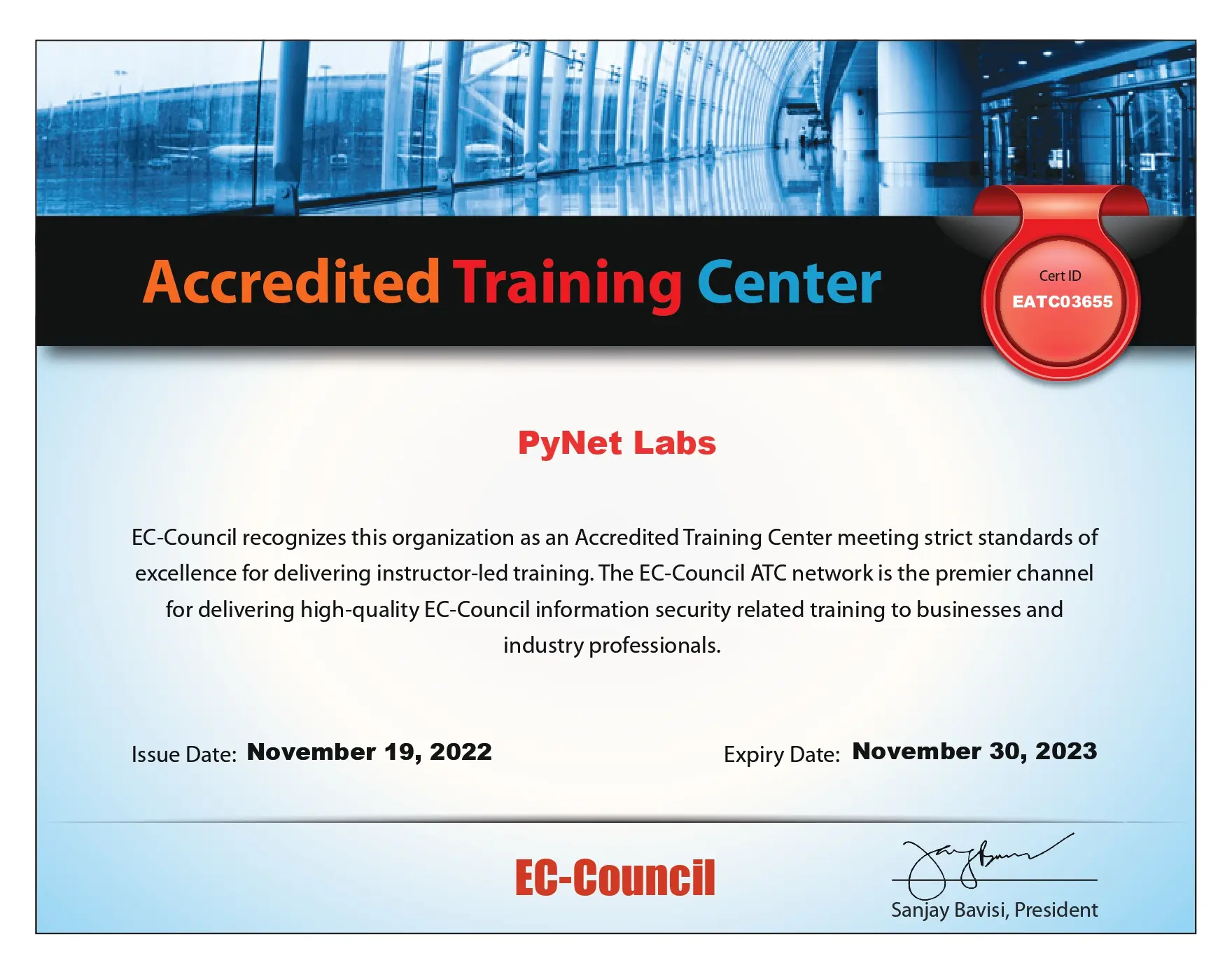
PyNet Labs is an accredited Training Center recognized by EC Council offering high-quality EC Council information security-related training.

As Cyber Security incidents are exploding, having Certified Ethical Hackers has been on the priority list for small to large size businesses, making CEH training the World’s Number 1 training and certification program.

It is a structured professional course for aspiring Cyber Professionals having global recognization. Throughout the Certified Ethical Hacker Course, you will be taught over 500+ Unique Attack Techniques and over 220 Challenge-Based, Hands-On Labs with CyberQ™ Labs. You will also learn a variety of tools and techniques across this evaluation process as well as how hackers will utilize the same TTPs to hack into organizations.

With PyNet Labs’ incomparable training benefits like instructor-led online training, official CEH course content, lifetime access to class recordings, flexible batches and experienced trainers, you can flourish in your training followed by CEH exam success. And, as PyNet Labs is EC Council’s accredited training center, you will have access to all the tools and study materials throughout your CEH Certification Course.

Why-Online-CEH-Course-from-PyNet-Labs

Pre-requisite

( i )  There are no specific prerequisites for the CEHv13 (Certified Ethical Hacker Course)

Who should attend CEH Training?

Anyone can take Certified Ethical hacker Course from PyNet Labs and embrace their ethical hacking skills. But, professionals with such job roles have a huge CEH Course demand.

  • Mid-Level Information Security Auditor
  • Cybersecurity Auditor
  • Security Administrator
  • IT Security Administrator
  • Cyber Defense Analyst
  • Vulnerability Assessment Analyst
  • Warning Analyst
  • Information Security Analyst 1
  • Security Analyst L1
  • Infosec Security Administrator
  • Cybersecurity Analyst level 1, level 2, & level 3
  • Network Security Engineer
  • SOC Security Analyst
  • Security Analyst
  • Network Engineer
  • Senior Security Consultant
  • Information Security Manager
  • Senior SOC Analyst
  • Solution Architect
  • Cybersecurity Consultant
Certified Ethical Hacker Course

Certified Ethical Hacker Course Outline

50 hours of instructor-led CEH Course Online consisting of 20 modules that
help you master the foundations of Ethical Hacking.

Learn the fundamentals and key issues in information
security, including the basics of ethical hacking, information
security controls, relevant laws, and standard procedures.

Learn how to use the latest techniques and tools
for footprinting and reconnaissance, a critical
pre-attack phase of ethical hacking.

Learn different network scanning techniques
and countermeasures.

Learn various enumeration techniques, including Border
Gateway Protocol (BGP) and Network File Sharing
(NFS) exploits and associated countermeasures.

Learn how to identify security loopholes in a target
organization’s network, communication infrastructure,
and end systems. Different types of vulnerability assessment
and vulnerability assessment tools are also included.

Learn about the various system hacking methodologies used
to discover system and network vulnerabilities, including
steganography, steganalysis attacks, and how to cover tracks.

Learn about different types of malware (Trojan, viruses,
worms, etc.), APT and fileless malware, malware analysis
procedures, and malware countermeasures.

Learn about packet sniffing techniques and their
uses for discovering network vulnerabilities, plus
countermeasures to defend against sniffing attacks.

Learn social engineering concepts and techniques,
including how to identify theft attempts, audit human-level
vulnerabilities, and suggest social engineering countermeasures.

Learn about different Denial of Service (DoS) and Distributed DoS
(DDoS) attack techniques, plus the tools used to audit a target
and devise DoS and DDoS countermeasures and protections.

Learn the various session-hijacking techniques used to discover
network-level session management, authentication, authorization,
and cryptographic weaknesses and associated countermeasures.

Learn about firewalls, intrusion detection systems (IDS),
and honeypot evasion techniques; the tools used to audit a
network perimeter for weaknesses; and countermeasures.

Learn about web server attacks, including a comprehensive
attack methodology used to audit vulnerabilities in
web server infrastructures and countermeasures

Learn about web application attacks, including a
comprehensive hacking methodology for auditing
vulnerabilities in web applications and countermeasures.

Learn about SQL injection attack techniques, evasion
techniques, and SQL injection countermeasures.

Learn about different types of encryption, threats,
hacking methodologies, hacking tools, security tools,
and countermeasures for wireless networks.

Learn mobile platform attack vectors, Android and
iOS hacking, mobile device management, mobile
security guidelines, and security tools.

Learn different types of Internet of Things (IoT)
and operational technology (OT) attacks, hacking
methodologies, hacking tools, and countermeasures.

Learn different cloud computing concepts, such as
container technologies and serverless computing,
various cloud computing threats, attacks, hacking
methodologies, and cloud security techniques and tools.

Learn about encryption algorithms, cryptography tools,
Public Key Infrastructure (PKI), email encryption, disk
encryption, cryptography attacks, and cryptanalysis tools

CEHv13 Practical Lab Outline

Module 1: Lab Setup & Fundamentals

Lab1- Installing Kali Linux on VirtualBox
Lab2- SettingupWindowsvictimmachine
Lab3- NAT & Host-Only Network
Lab4- Linux commands for hackers
Outcome: Students build and understand their own hacking lab

Module 3: Network Scanning

Lab 1- Live host discovery
Lab 2- Port scanning using Nmap
Lab 3- Service & OS detection
Lab 4- Vulnerability scanning basics
Tools: Nmap, Zenmap

Module 5: Vulnerability Assessment

Lab 1- Using vulnerability scanners
Lab 2- Identifying system weaknesses
Tools: OpenVAS / Nessus / Nmap

Module 7: Malware & Threat Concepts

Lab 1- Creating basic payloads (educational)
Lab 2- Understanding trojans & backdoors
Tools: msfvenom / Metasploit

Module 9: Social Engineering

Lab 1- Phishing attack simulation
Lab 2- Credential harvesting demo
Tools: SET (Social Engineering Toolkit) / Zphisher

Module 11: Session Hijacking

Lab 1- Understanding session management flaws
Lab 2- Concept of session takeover
Tools: Wireshark / Burp Suite

Module 13: Wireless Security

Lab 1- Wireless network vulnerabilities
Lab 2- Security mechanisms in Wi-Fi
Tools: Aircrack-ng

Module 2: Footprinting & Reconnaissance

Lab 1- Gathering information using:
1. WHOIS Lookup
2. NSLookup
3. Google Dorking
Lab 2- Website reconnaissance Tools: Whois, Maltego, Recon-ng

Module 4: Enumeration

Lab 1- SMB Enumeration
Lab 2- NetBIOS Enumeration
Lab 3- SNMP Enumeration
Tools: Enum4linux, Netcat

Module 6: System Hacking Concepts

Lab1- Password cracking using brute force
Lab2- Hash cracking
Lab3- Privilege escalation basics Tools: Hydra

Module 8: Sniffing

Lab 1- Capturing network traffic
Lab 2- Analyzing packets
Tools: Wireshark

Module 10: Denial of Service Concepts

Lab 1- Understanding service disruption attacks
Lab 2- Impact and prevention
Tools: Slowloris / hping3

Module 12: Web Application Security

Lab 1- SQL Injection basics
Lab 2- XSS (Cross-Site Scripting)
Tools: DVWA, Burp Suite

Module 14: Cryptography Basics

• Encryption and hashing concepts
• Importance of secure communication

How To Enroll?

Get personalized guidance across IT, networking, cloud, security, automation, data, DevOps, and more.
Our experts help you figure out the right learning path and enrollment plan for your goals.

Fill your details

Find the right learining path with expert guidance

Call Us

Instant guidance on courses fees and batches

Chat on whatsapp

Get course details, demo and batch timings instantly

Job Roles After CEH Course

After completing the CEH v13 course, you can apply for roles like:

Ethical Hacker
Security Analyst
SOC Analyst
Network Security Engineer
Vulnerability Analyst
Cybersecurity Consultant

Tools Covered in CEH Online Course

Nikto
Metasploit
WPscan
NMAP
Owasp zap
Vmware
Wireshark
Amass
Burpsuit
Kali Linux

Accredited Training Center

Sarvajith Tech Park ECC ATC Cert 1 1

Accreditations

iso
cisco11
EC Council
msme
5 1

Learn from Industry Experts

What Our Students Say About Us

Frequently Asked Questions

Q1. What is the Certified Ethical Hacker (CEH) course?

The Certified Ethical Hacker (CEH) course is a comprehensive training program that teaches individuals how to think and act like a hacker, but with the purpose of identifying and fixing security vulnerabilities rather than exploiting them. It covers various aspects of ethical hacking, including penetration testing, network security, and security assessment.

Q2. Who is this course designed for?

The CEH course is designed for IT professionals, security officers, auditors, and anyone interested in learning how to protect computer systems and networks from cyber threats. It is suitable for beginners and experienced individuals looking to enhance their cybersecurity skills.

Q3. What topics are covered in the CEH course?

The CEH course covers a wide range of topics, including ethical hacking concepts, information security, footprinting and reconnaissance, scanning networks, enumeration, system hacking, malware threats, sniffing, social engineering, web application hacking, and more. It provides hands-on experience and practical knowledge in these areas.

Q4. Is there a certification exam for CEH?

Yes, there is a CEH certification exam that you can take after completing the course. The exam tests your knowledge and skills in ethical hacking and cybersecurity. Passing the exam will earn you the Certified Ethical Hacker certification, which is globally recognized and valued in the cybersecurity industry.

Q5. How long does it take to complete the CEH course?

The duration of the CEH course may vary depending on the  learning format. Typically, it can take anywhere from a few weeks to a few months to complete the course, including preparation for the certification exam.

Q6. What are the benefits of becoming a Certified Ethical Hacker?

Becoming a Certified Ethical Hacker opens up various career opportunities in the cybersecurity field. It demonstrates your expertise in ethical hacking and cybersecurity, making you a valuable asset to organizations. You can work as a security analyst, penetration tester, security consultant, or in other cybersecurity roles. CEH certification can also lead to higher earning potential.

Q7. Where can I find more information about the CEH course?

You can find more information about the Certified Ethical Hacker (CEH) course, including course details, registration, and study materials, on the official website of EC-Council (the certification body) or through authorized training providers like PyNet Labs.