


Introduction
What if your infrastructure could build itself, configure itself, and scale without repetitive manual work? This is where Ansible and Terraform become important in modern DevOps. Although both automate infrastructure tasks, they solve different problems and operate at different stages of the infrastructure lifecycle.
Ansible is primarily used for configuration management, application deployment, and automation, while Terraform focuses on provisioning and managing infrastructure as code. In this Ansible vs Terraform blog, we will explore their key differences, features, use cases, similarities, and how they can work together. By the end, you will know which tool is better suited to your specific automation requirements.
What is Ansible?
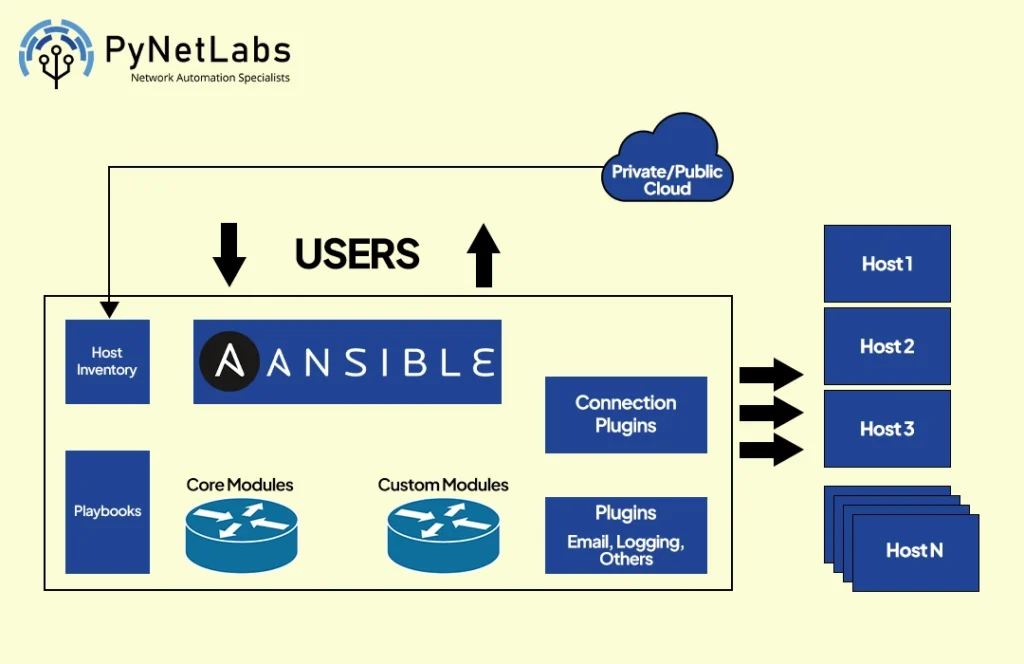
Ansible is an open-source automation platform used for configuration management, application deployment, orchestration, and IT automation. It uses human-readable YAML playbooks to define tasks and manage the desired state of systems. Ansible is agentless, so it can typically connect to managed hosts using SSH for Linux and Unix systems or WinRM for Windows systems.
Ansible uses modules to perform specific tasks, while playbooks organise those tasks into repeatable automation workflows. Its idempotent modules help ensure that systems reach the required state without making unnecessary changes when the desired state has already been achieved. This makes Ansible particularly useful for configuring servers, deploying applications, managing users and packages, and automating recurring operational tasks.
If you’re looking to get comfortable using these tools in real-world scenarios, an Ansible and Terraform course is a great way to gain both hands-on experience and a solid understanding of the concepts behind them.

Key Features of Ansible
Ansible simplifies IT automation with a flexible, agentless architecture and human-readable playbooks. Its reusable modules and roles help teams manage systems, deploy applications, and automate repetitive tasks consistently.
- Agentless Architecture: Connects to managed systems without requiring a dedicated agent.
- YAML-based Playbooks: Uses readable YAML files to define automation tasks and workflows.
- Modules: Provides reusable components for performing specific automation tasks.
- Inventories: Defines the hosts and groups that Ansible manages.
- Roles: Organises reusable automation content into a standard structure.
- Idempotency: Most modules can apply changes only when the desired state has not already been reached.
- Jinja2 Templating: Enables dynamic configuration files and reusable templates.
- Broad Platform Support: Can automate servers, cloud environments, applications, and network devices.
What is Terraform?
Terraform is an Infrastructure as Code (IaC) tool originally created by HashiCorp for provisioning and managing infrastructure through configuration files. It uses HashiCorp Configuration Language (HCL), a declarative language that allows users to define the resources and configuration they want rather than specifying every execution step.
Terraform uses providers to interact with cloud platforms, SaaS products, and other APIs. It also maintains a state file that maps the resources defined in the configuration to real-world infrastructure. This state allows Terraform to determine what needs to be created, updated, or removed when the configuration changes.
Terraform follows a plan-and-apply workflow. The terraform plan command previews proposed changes, while terraform apply executes them. This makes infrastructure changes easier to review, automate, and manage consistently.
Key Features of Terraform
Terraform provides a structured way to define, provision, and manage infrastructure through code. Its features support consistent deployments, reusable configurations, and better control over infrastructure changes.
- Infrastructure as Code: Defines infrastructure using version-controlled configuration files.
- Declarative Configuration: Describes the desired infrastructure state rather than individual execution steps.
- State Management: Maintains state to map configuration to real-world infrastructure.
- Plan and Apply Workflow: Allows teams to preview changes before applying them.
- Providers: Connects Terraform with cloud platforms, SaaS products, and other APIs.
- Reusable Modules: Enables teams to package and reuse infrastructure configurations.
- Dependency Management: Builds relationships between resources and determines the order in which dependent resources should be managed.
- Multi-platform Support: Supports infrastructure across major cloud platforms and many other provider-based services.

Ansible vs Terraform
Ansible and Terraform both automate infrastructure, but they serve different primary purposes: Terraform provisions and manages infrastructure, while Ansible configures systems, deploys applications, and automates operations.
| Feature | Ansible | Terraform |
| Primary purpose | Configuration, deployment, and automation | Infrastructure provisioning and lifecycle management |
| Language | YAML playbooks | HCL (HashiCorp Configuration Language) |
| Automation model | Task-based with defined order | Declarative desired state |
| State management | No persistent infrastructure state file | Uses state to track infrastructure |
| How it works | Connects to hosts via SSH or WinRM | Uses providers to interact with APIs |
| Agentless | Yes | Yes |
| Planning | Check mode previews changes | terraform plan previews changes |
| Best suited for | Servers, applications, patching, and operations | VMs, networks, databases, load balancers, and IAM |
| Lifecycle management | Configures existing systems | Creates, updates, and destroys infrastructure |
| Cloud provisioning | Supported through modules and collections | Core use case |
| Configuration management | Core strength | Not its primary purpose |
| Typical workflow | Configure and deploy to hosts | Plan and apply infrastructure changes |
Primary Purpose
The biggest difference between Ansible and Terraform is the layer of the environment they primarily manage. Terraform is designed to provision and manage infrastructure resources such as virtual machines, networks, databases, DNS records, and load balancers through providers and APIs.
Ansible is designed for configuration management, application deployment, and operational automation. It can install packages, manage users, configure services, deploy applications, apply updates, and automate tasks across managed systems. This makes Ansible particularly useful after infrastructure has already been provisioned.
Configuration and Automation Model
Terraform uses a declarative configuration model. Instead of specifying every individual execution step, users describe the infrastructure they want in configuration files, and Terraform creates an execution plan to determine the required changes. Its plan-and-apply workflow makes infrastructure changes easier to review before they are implemented.
Ansible uses YAML-based playbooks that define tasks and their execution order. However, describing Ansible simply as a “procedural” tool is misleading because Ansible modules commonly work with desired-state and idempotent behaviour. If a managed system already matches the required state, Ansible can avoid making unnecessary changes.
State Management
State management is an important distinction between the two tools. Terraform maintains state that maps resources in its configuration to real infrastructure and uses that information to determine which resources need to be created, updated, or removed.
Ansible does not maintain an equivalent persistent infrastructure state file. Instead, it connects to managed systems and evaluates their current condition while executing tasks. Its idempotent modules help maintain the desired configuration without requiring Terraform-style state tracking.
Infrastructure Lifecycle Management
Terraform is designed to manage the lifecycle of infrastructure resources. Depending on the provider and resource, it can create new resources, update existing resources in place, or destroy and recreate resources when an in-place update is not supported.
Ansible is more focused on ongoing configuration and operational management. For example, it can install software on an existing server, modify configuration files, manage services, deploy applications, and apply operating system updates. This makes it well suited to maintaining systems after infrastructure has been provisioned.
Packaging and Templating Support
Ansible provides strong support for reusable automation through roles, modules, collections, and Jinja2 templates. Jinja2 can generate dynamic configuration files, while roles help organise related tasks, variables, handlers, templates, and files into reusable automation structures. This makes Ansible useful when configurations need to vary across systems or environments.
Terraform also supports reusable infrastructure through modules, variables, and expressions. However, Terraform modules are primarily intended to package infrastructure configurations rather than act as a general-purpose configuration templating system. Its strength is reusable infrastructure definitions, while Ansible is generally better suited to dynamic system and application configuration.
Community and Licensing
Ansible has an open-source community edition and a broad ecosystem of modules, collections, and related automation content. Its ecosystem supports automation across operating systems, applications, cloud environments, and network devices, making it suitable for a wide range of infrastructure and operational tasks.
Terraform has a large provider and module ecosystem through the Terraform Registry. Providers allow Terraform to interact with cloud platforms, SaaS products, and other APIs, while modules help teams create reusable infrastructure configurations. When evaluating Terraform, organisations should also consider its current licensing model and whether it fits their technical and organisational requirements.
Learn python and ansible for networking with Network Automation Course with Python, Ansible & APIs – Sign up to know more!
Ansible vs Terraform: Which One Should You Choose?
Neither Ansible nor Terraform is universally better. The right choice depends on what you need to automate.
Choose Terraform when your primary requirement is to provision and manage infrastructure. It is particularly useful when you need to create cloud resources, manage infrastructure dependencies, review changes through an execution plan, and maintain a persistent state of managed resources.
Choose Ansible when your primary requirement is configuration management or application deployment. It is well suited to installing software, configuring operating systems, managing services, deploying applications, and automating recurring operational tasks. If your environment requires both infrastructure provisioning and system configuration, using Terraform and Ansible together is often the most practical approach.
Use Cases: When to Use Ansible or Terraform
Ansible is best suited for configuring systems, deploying applications, and automating operational tasks. Terraform is designed for provisioning and managing infrastructure such as networks, virtual machines, databases, and cloud resources.
When to Use Ansible
Ansible is a good choice when you need to automate configuration or operational tasks on existing systems.
Common use cases include:
- Installing and updating software packages
- Managing users, groups, and permissions
- Configuring web servers and application servers
- Deploying applications
- Managing configuration files
- Applying operating system patches
- Automating network device configuration
- Running repeatable operational workflows
- Managing configuration across on-premises and cloud environments
When to Use Terraform
Terraform is a good choice when you need to provision or manage infrastructure through APIs.
Common use cases include:
- Creating virtual machines
- Building VPCs, subnets, and network infrastructure
- Deploying databases and storage
- Configuring load balancers
- Managing DNS resources
- Managing IAM resources
- Provisioning Kubernetes infrastructure
- Managing multi-cloud infrastructure
- Creating reusable infrastructure modules
Can Terraform and Ansible Be Used Together?
Yes. Terraform and Ansible are often used together because they solve different parts of the infrastructure automation lifecycle.
A common workflow is:
- Terraform provisions the infrastructure such as networks, virtual machines, databases, and load balancers.
- Terraform exposes required outputs such as IP addresses, hostnames, or resource information.
- Ansible connects to the provisioned systems and configures the operating system and applications.
- Ansible deploys and manages workloads such as packages, services, configuration files, and application code.
This creates a clear division of responsibility: Terraform manages infrastructure, while Ansible manages configuration and application-level automation. Using both tools can reduce the temptation to force one tool to perform tasks for which the other is better suited.
Ansible vs Terraform: Similarities
Although Ansible and Terraform have different primary purposes, they share several characteristics:
- Automation: Both reduce repetitive manual infrastructure and IT tasks.
- Code-based Management: Both allow automation configurations to be stored and managed as code.
- Agentless Operation: Neither requires a traditional persistent agent to be installed on managed infrastructure.
- Reusability: Both support reusable automation components through Ansible roles/modules and Terraform modules.
- Version Control: Both can be integrated with Git-based workflows.
- Cloud Support: Both can automate resources and operations across cloud environments.
- DevOps Integration: Both can be incorporated into CI/CD and infrastructure automation workflows.
- Idempotent Behaviour: Both can help produce predictable outcomes when configurations and automation are designed appropriately.
Terraform Licensing and OpenTofu
Terraform was originally distributed under the Mozilla Public License 2.0 (MPL 2.0). HashiCorp changed Terraform’s licence to the Business Source License (BUSL) in 2023. Following that change, OpenTofu was created as an open-source fork of Terraform.
For organisations evaluating infrastructure-as-code tools, licensing can therefore be an additional consideration alongside features, ecosystem support, compatibility, and operational requirements. ore be an additional consideration alongside features, ecosystem support, compatibility, and operational requirements.
Conclusion
Ansible and Terraform solve different but complementary automation challenges. Terraform is primarily suited to provisioning and managing infrastructure through declarative configuration and state management, while Ansible excels at configuration management, application deployment, and operational automation. Instead of treating them as competing tools, teams can use Terraform to build infrastructure and Ansible to configure it, creating a more complete and repeatable DevOps workflow.
Frequently Asked Questions
Q1. Is Ansible an Infrastructure as Code Tool?
Ansible can be used for infrastructure automation and configuration as code, but its primary strength is configuration management, application deployment, and orchestration. Terraform is more specifically focused on provisioning and managing infrastructure as code.
Q2. Do I Need Ansible with Terraform?
Terraform and Ansible complement each other. Using them together can significantly enhance your workflows and simplify the tasks around managing, provisioning, and configuring your infrastructure.
Q3. Can Ansible Replace Terraform?
Ansible can provision some infrastructure resources through its modules and collections, but it does not provide Terraform’s state-based infrastructure management model. For complex infrastructure provisioning and lifecycle management, Terraform is generally the more suitable choice.
Q4. Is Terraform Better Than Ansible?
Neither tool is universally better. Terraform is generally better suited to infrastructure provisioning and lifecycle management, while Ansible is better suited to server configuration, application deployment, and operational automation.